
Running a catering trailer business in Minnesota requires more than just great recipes and excellent customer service. Whether you're serving gourmet tacos at Minneapolis festivals or operating a coffee trailer in Rochester, protecting your mobile business with the right insurance coverage is essential. Catering trailer insurance safeguards your investment against accidents, liability claims, equipment damage, and unexpected events that could otherwise devastate your business financially. Understanding your coverage options and requirements ensures you're prepared for whatever challenges come your way while keeping your business running smoothly.
Why Catering Trailer Businesses Need Specialized Insurance
Traditional business insurance policies don't adequately cover the unique risks associated with mobile food operations. Your catering trailer represents a significant investment, typically ranging from $15,000 to over $100,000 depending on equipment and customization. Without proper coverage, you're personally liable for damages, injuries, or losses.
Mobile food vendors face distinct challenges that require specialized insurance protection. You're operating a commercial kitchen on wheels, which means you're exposed to risks both on the road and at your service locations. Your business involves transporting potentially hazardous equipment, cooking with open flames or electrical systems, serving food to the public, and parking in various locations throughout Minnesota communities.
The financial consequences of operating without adequate catering trailer insurance can be catastrophic. A single foodborne illness claim could result in legal fees exceeding $50,000, while a major accident involving your trailer could destroy your entire business overnight. Minnesota food vendors must also meet specific regulatory requirements that mandate certain insurance coverages before obtaining permits and licenses.
Understanding Minnesota's Regulatory Landscape
Minnesota health departments and municipalities require food vendors to carry specific insurance coverages before issuing permits. Most counties demand proof of insurance as part of the licensing process, and many events and festivals won't allow vendors without proper documentation.
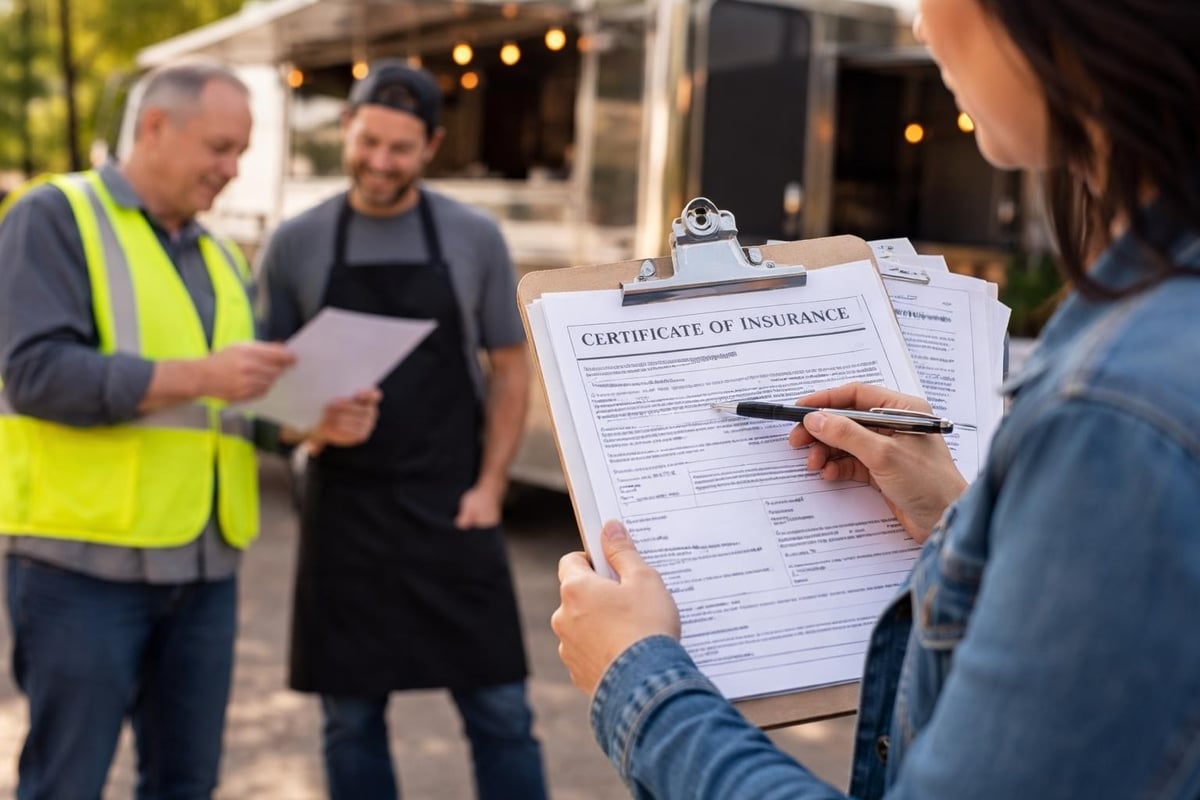
The Minnesota Department of Health oversees mobile food unit regulations, but individual counties like Stearns, Benton, and Morrison have additional requirements. St. Cloud, Duluth, and Mankato each maintain their own vendor permitting systems that include insurance verification steps.
Essential Coverage Types for Catering Trailer Insurance
Comprehensive catering trailer insurance combines multiple policy types to protect every aspect of your mobile food business. Understanding each coverage component helps you build a policy that addresses your specific operational risks and meets all legal requirements.
Commercial Auto Insurance for Your Trailer
Your commercial auto insurance forms the foundation of your catering trailer protection. This coverage protects your vehicle and trailer while traveling between locations, events, and your storage facility. Standard personal auto policies explicitly exclude business use, leaving you completely unprotected during commercial operations.
Commercial auto coverage includes several important components:
- Liability protection covering bodily injury and property damage you cause to others
- Collision coverage paying for repairs after accidents regardless of fault
- Comprehensive coverage protecting against theft, vandalism, fire, and weather damage
- Medical payments covering injuries to you and your passengers
Minnesota law requires minimum liability limits of $30,000 per person and $60,000 per accident for bodily injury, plus $10,000 for property damage. However, these minimums provide inadequate protection for most catering businesses. Industry experts recommend carrying at least $500,000 in liability coverage, with $1 million being increasingly common for serious food entrepreneurs.
General Liability Protection
General liability insurance protects your business when customers or third parties suffer injuries or property damage due to your operations. This coverage is absolutely critical for food service businesses because you're inviting the public to interact with your business in various settings.
Consider these real-world scenarios where general liability coverage protects you:
- A customer trips over your trailer's stabilizing jack and breaks their wrist
- Hot cooking oil spills and burns a customer waiting in line
- Your awning collapses during setup, damaging another vendor's equipment
- A customer claims your trailer damaged the event venue's pavement
Most venues and event organizers require vendors to carry between $1 million and $2 million in general liability coverage. They'll also typically require you to name them as "additional insured" on your policy, which extends your coverage to protect them from liability claims arising from your operations.
Product Liability and Food Contamination Coverage
Product liability insurance specifically addresses claims arising from the food and beverages you serve. This coverage is non-negotiable for catering businesses because even with perfect food safety practices, contamination risks exist. Understanding product liability protection helps you appreciate why this coverage is essential for any food service operation.
Product liability covers:
- Foodborne illness claims from bacterial contamination
- Allergic reactions despite proper ingredient disclosure
- Foreign objects accidentally included in food
- Claims of false advertising regarding ingredients or preparation methods
A single foodborne illness outbreak affecting multiple customers at a wedding or corporate event could generate claims totaling hundreds of thousands of dollars. Product liability insurance covers your legal defense costs, settlements, and judgments up to your policy limits.
Equipment and Property Coverage Options
Your catering trailer contains thousands of dollars in specialized equipment that needs protection beyond basic auto coverage. Equipment breakdown, theft, and damage represent serious financial threats to your business continuity.
| Coverage Type | What It Protects | Typical Limits |
|---|---|---|
| Inland Marine | Equipment during transport and at events | $10,000-$100,000 |
| Business Property | Equipment while stored at your location | Actual value of contents |
| Equipment Breakdown | Mechanical/electrical system failures | $25,000-$50,000 |
| Refrigeration Coverage | Spoilage from equipment failure | $5,000-$15,000 |
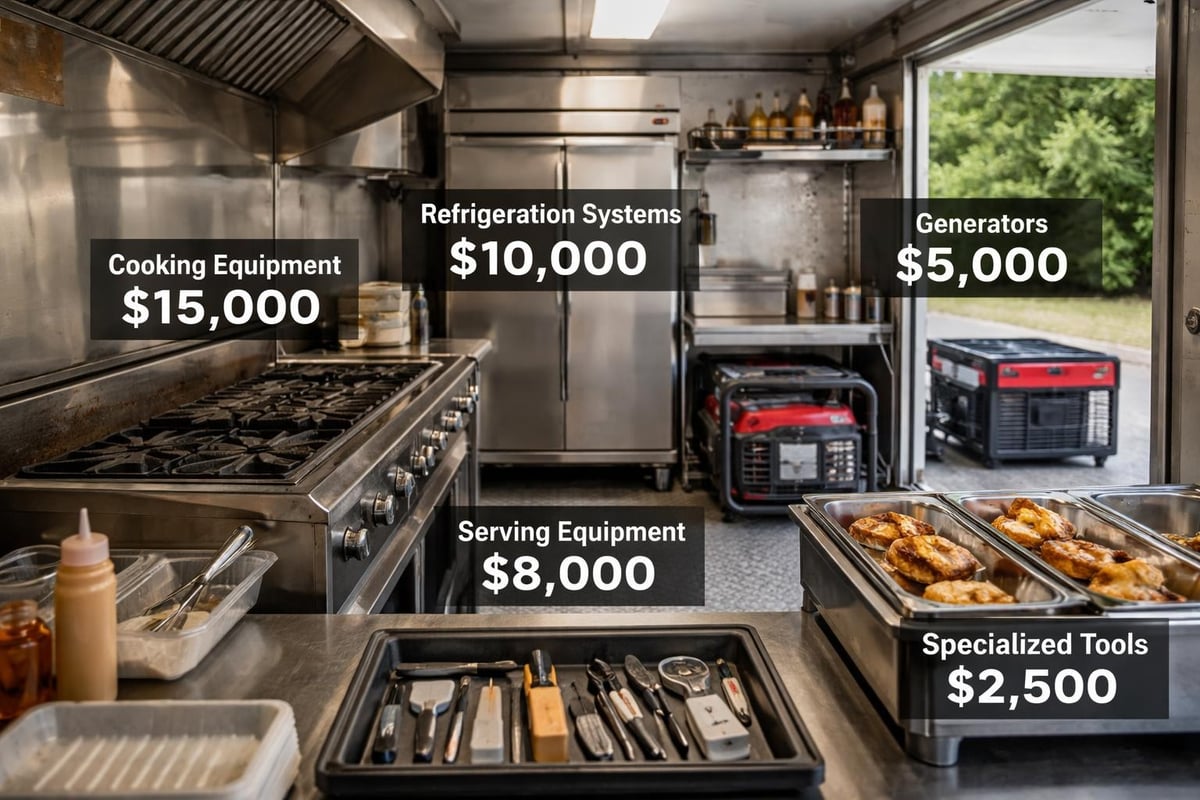
Inland marine insurance protects your equipment while it's in transit or being used at temporary locations. This coverage is specifically designed for businesses with mobile operations, making it perfect for catering trailers operating throughout Minnesota. Unlike commercial property insurance, which only covers items at fixed locations, inland marine follows your equipment wherever you go.
Protecting Your Income During Interruptions
Business interruption insurance replaces lost income when covered events force you to temporarily cease operations. For catering businesses dependent on regular weekend events and seasonal festivals, even a short closure can devastate your cash flow and jeopardize your ability to pay fixed expenses.
This coverage activates when:
- Your trailer suffers major damage requiring extensive repairs
- Equipment breakdown prevents you from operating safely
- Mandatory closures follow foodborne illness investigations
- Your storage facility becomes unusable due to fire or natural disasters
Business interruption insurance typically covers lost profits, continuing expenses like loan payments and insurance premiums, and additional costs needed to maintain operations during recovery. Most policies require a waiting period of 48-72 hours before coverage begins, so brief interruptions may not qualify for reimbursement.
Building the Right Policy for Your Minnesota Operation
Selecting appropriate coverage limits and policy features requires careful analysis of your specific business model, equipment value, revenue levels, and risk exposure. Cookie-cutter policies rarely provide optimal protection for mobile food businesses.
Factors Affecting Your Insurance Costs
Insurance companies evaluate numerous factors when calculating your catering trailer insurance premiums. Understanding these variables helps you make informed decisions about coverage and potentially reduce your costs.
Business experience and history: New operators typically pay 20-30% more than established businesses with proven track records. Your claims history significantly impacts pricing, with even one significant claim potentially doubling your premiums.
Coverage limits and deductibles: Higher liability limits increase premiums proportionally, while choosing higher deductibles can reduce your premium by 15-25%. Most Minnesota vendors select $500-$1,000 deductibles to balance affordability with out-of-pocket exposure.
Equipment value and trailer type: A basic food trailer with minimal equipment might require only $25,000 in property coverage, while a fully custom unit could need $75,000 or more. The more valuable your equipment, the higher your premiums.
Operating territory and venues: Where you operate affects your risk profile. Vendors primarily working private events face different risks than those operating at large public festivals. Operating across multiple Minnesota counties may increase premiums compared to limiting operations to St. Cloud or Brainerd areas.
Annual revenue and sales volume: Insurance companies typically charge premiums as a percentage of gross receipts, commonly ranging from 1-3% of annual revenue for comprehensive coverage packages.
Working With Independent Insurance Brokers
Independent brokers access multiple insurance carriers, allowing them to compare coverage options and pricing to find your best solution. Unlike captive agents representing single companies, independent brokers work for you, not insurance companies. This approach often results in savings of 15-30% compared to purchasing directly from individual carriers.
General insurance agencies with experience in commercial coverage understand the nuances of food service operations. They can identify coverage gaps that inexperienced agents might miss, such as ensuring your policy includes hired and non-owned auto liability for employees using personal vehicles on business errands.
Risk Management Strategies to Lower Insurance Costs
Implementing strong risk management practices demonstrates to insurance companies that you're a responsible operator committed to preventing losses. Many carriers offer premium discounts ranging from 10-25% for businesses with documented safety programs.
Food Safety and Training Programs
Comprehensive food safety training for all staff members reduces product liability risk while potentially qualifying you for insurance discounts. Minnesota food handler certification programs teach proper temperature control, cross-contamination prevention, and hygiene practices that prevent foodborne illness.
Key risk management practices include:
- Maintaining detailed temperature logs for all refrigerated items
- Implementing first-in, first-out inventory rotation systems
- Creating written procedures for cleaning and sanitization
- Documenting allergen controls and ingredient tracking
- Conducting regular equipment maintenance and inspections
Vehicle Safety and Maintenance
Your trailer represents both a significant asset and potential liability. Proper maintenance prevents accidents while protecting your equipment investment. Reviewing insurance documentation requirements helps ensure you understand what carriers expect regarding vehicle upkeep.
Establish a preventive maintenance schedule covering:
- Brake system inspections every 3,000 miles
- Tire pressure and tread depth checks before each trip
- Electrical system testing monthly
- Propane system leak testing quarterly
- Generator servicing according to manufacturer specifications
Document all maintenance activities, as insurance companies may request these records when processing claims or during underwriting reviews.
Special Considerations for Seasonal Operations
Many Minnesota catering businesses operate seasonally, concentrating activities during spring through fall when festivals and outdoor events dominate the calendar. Seasonal operations present unique insurance challenges and opportunities.
Seasonal policies can reduce costs significantly compared to year-round coverage. Some carriers offer lay-up discounts of 30-50% during winter months when your trailer remains in storage. However, you'll need to maintain comprehensive and liability coverage even during inactive periods to protect against theft, vandalism, and storage-related risks.
Winter Storage Requirements
Proper winter storage protects your investment while potentially qualifying you for insurance discounts. Most policies require trailers to be stored in secure locations, typically defined as fully enclosed buildings or fenced lots with controlled access.
Storage requirements often include:
- Removing propane tanks or ensuring valves are fully closed
- Winterizing water systems to prevent freeze damage
- Disconnecting batteries or maintaining trickle chargers
- Covering or protecting sensitive equipment from moisture
- Maintaining climate control to prevent extreme temperature damage
Navigating Insurance Claims Successfully
Understanding the claims process before you need it ensures faster resolution and better outcomes when incidents occur. Time-sensitive actions immediately following accidents or losses significantly impact claim success.
Immediate Steps After Incidents
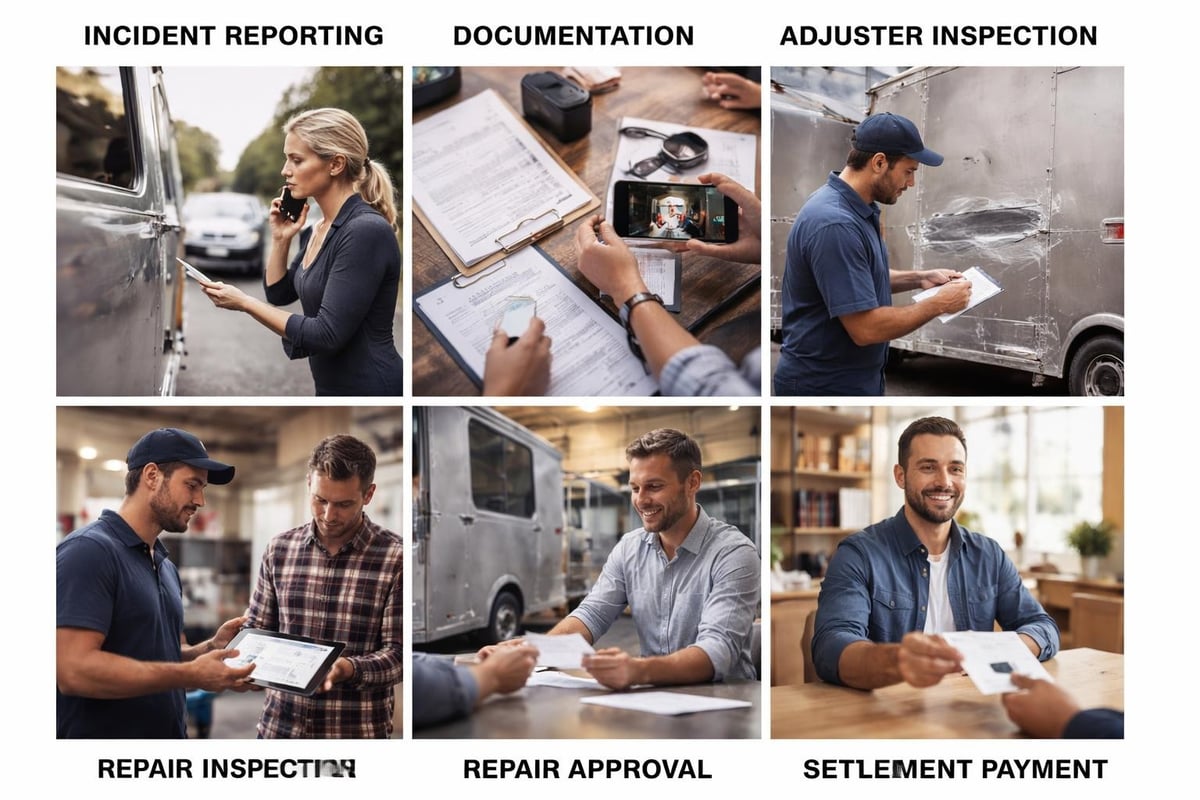
When accidents, injuries, or property damage occur, your immediate response affects both claim outcomes and legal liability. Take these actions immediately:
- Ensure safety first by addressing any immediate dangers or providing first aid
- Document everything through photos, videos, and written notes
- Collect information from all parties including witnesses, venue operators, and other vendors
- Notify your insurance company within 24 hours regardless of fault or perceived severity
- Preserve evidence by avoiding repairs until the adjuster inspects damage
Never admit fault or make statements about liability at the accident scene. Express concern for injured parties while avoiding any language that could be construed as accepting responsibility. Let your insurance company's legal team handle liability determinations.
Working With Adjusters and Protecting Your Interests
Insurance adjusters investigate claims to determine coverage and appropriate compensation. While adjusters generally work fairly, remember they represent the insurance company's interests, not necessarily yours. Understanding this relationship helps you advocate effectively for full compensation.
Prepare for adjuster meetings by:
- Organizing all documentation including repair estimates, revenue records, and incident reports
- Creating detailed inventories of damaged equipment with purchase receipts and current values
- Calculating business interruption losses with supporting financial records
- Obtaining multiple repair estimates from qualified professionals
- Understanding your policy terms, limits, and coverage provisions
Comparing Coverage Packages and Making Informed Decisions
Shopping for catering trailer insurance requires comparing more than just premium costs. Coverage breadth, policy limits, exclusions, deductibles, and carrier financial strength all impact the true value of insurance policies.
Create a comparison framework evaluating these factors:
| Evaluation Factor | Weight | Carrier A | Carrier B | Carrier C |
|---|---|---|---|---|
| Premium Cost | 25% | $2,400/year | $2,100/year | $2,650/year |
| Liability Limits | 20% | $1M | $1M | $2M |
| Equipment Coverage | 20% | $50,000 | $40,000 | $60,000 |
| Business Interruption | 15% | Included | Not offered | $10,000 limit |
| Product Liability | 15% | $1M | $500,000 | $1M |
| Customer Service | 5% | Good | Excellent | Fair |
Request certificates of insurance samples before purchasing to ensure carriers can provide the documentation venues and municipalities require. Some carriers take days or weeks to issue certificates, potentially causing you to miss event opportunities.
Understanding Policy Exclusions and Limitations
Every insurance policy contains exclusions limiting coverage under certain circumstances. Understanding these limitations prevents unpleasant surprises when filing claims. Common catering trailer insurance exclusions include:
- Intentional acts: Deliberate damage or contractual liabilities you voluntarily assume
- Mechanical breakdown: Normal wear and tear or maintenance-related failures unless you purchase equipment breakdown coverage
- Employee injuries: Staff injuries require separate workers’ compensation insurance
- Professional liability: Claims arising from consulting, menu planning, or advisory services
- Pollution and contamination: Some policies exclude environmental damage unless specifically endorsed
Review business insurance for commercial operations to understand how various coverage types work together to provide comprehensive protection.
Additional Coverage Enhancements Worth Considering
Beyond basic catering trailer insurance requirements, several optional coverages provide valuable protection for specific situations. Evaluate these enhancements based on your unique risk profile and operational characteristics.
Liquor Liability Insurance
If you serve alcohol at events, even just beer and wine, standard liability policies typically exclude alcohol-related claims. Liquor liability insurance covers claims arising from serving intoxicated patrons who subsequently cause injuries or property damage.
Minnesota's dram shop laws hold alcohol servers liable for damages caused by obviously intoxicated or underage patrons. This coverage is essential for any catering operation offering bar services, with annual premiums typically ranging from $500-$2,000 depending on alcohol sales volume.
Cyber Liability and Data Breach Coverage
Modern catering businesses collect customer information through point-of-sale systems, online ordering platforms, and customer databases. Cyber insurance protection addresses data breaches, payment card theft, and cyber attacks that compromise customer information.
Even small mobile vendors face cyber risks. A data breach exposing customer credit card information could result in notification costs, credit monitoring services, regulatory fines, and lawsuits. Cyber liability policies typically cost $500-$1,500 annually for small catering operations with modest data exposure.
Umbrella and Excess Liability Policies
Umbrella policies provide additional liability limits above your primary coverages, activating when underlying policies reach their limits. For example, if you carry $1 million in general liability but face a $2 million judgment, umbrella coverage pays the excess $1 million.
Umbrella policies are remarkably affordable, often costing only $200-$400 annually for an additional $1-2 million in coverage. This extra protection proves invaluable when catastrophic events generate claims exceeding standard policy limits.
Growing Your Business With Proper Insurance Protection
As your catering business expands, your insurance needs evolve. Adding employees, purchasing additional trailers, expanding your menu offerings, or entering new market segments all create new insurance considerations. Reviewing your coverage annually with your broker ensures your policies grow alongside your business.
Planning for growth includes:
- Scheduling coverage reviews before adding equipment or employees
- Updating policy limits to reflect increased revenue and asset values
- Modifying coverage territories when expanding to new Minnesota regions like Bemidji or Moorhead
- Adding endorsements for new services or operational changes
- Evaluating carrier options as your business profile changes
Successful catering businesses often outgrow their initial insurance carriers as they develop more complex needs. What worked perfectly for a startup operation may prove inadequate or overpriced for an established business with multiple units and employees. Understanding mobile catering insurance options helps you anticipate how coverage should evolve with your business.
Protecting your catering trailer business with comprehensive insurance isn't just about meeting regulatory requirements; it's about safeguarding the business you've built and ensuring long-term success. With over 35 insurance carriers and deep expertise in commercial coverage, Guardian Insurance Services MN helps Minnesota catering businesses find the right protection at competitive rates. Our independent approach means we work for you, comparing options from multiple carriers to build customized policies that address your specific needs. Contact our Albany or Freeport offices today to discuss your catering trailer insurance requirements and discover how we can protect your mobile food business.