
Every Minnesota business owner faces critical decisions about protecting their workforce, and understanding insurance and workers compensation stands at the forefront of these choices. Whether you're running a farm in Stearns County, operating a manufacturing facility in the Twin Cities metro, or managing a retail operation in greater Minnesota, workers compensation insurance isn't just a legal requirement-it's your financial safeguard against workplace injuries and illnesses that could otherwise devastate your business. This comprehensive guide breaks down everything Minnesota employers need to know about securing proper coverage, managing costs, and ensuring compliance with state regulations.
Why Minnesota Businesses Need Workers Compensation Coverage
Minnesota law mandates that nearly all employers carry workers compensation insurance, making it one of the most essential forms of commercial insurance for business protection. This requirement kicks in when you employ even a single full-time or part-time worker, with very limited exceptions.
The fundamental purpose of insurance and workers compensation is straightforward: protect both employees and employers when workplace accidents occur. For your workers, this coverage provides immediate access to medical treatment, wage replacement during recovery, and rehabilitation services without the need to prove fault. For business owners across Albany, Freeport, and surrounding Minnesota communities, workers compensation serves as a crucial liability shield.
Key protection elements include:
- Medical expense coverage for work-related injuries and illnesses
- Partial wage replacement during recovery periods
- Vocational rehabilitation for employees unable to return to previous roles
- Death benefits for families of workers killed in workplace accidents
- Legal defense against employee lawsuits related to workplace injuries
Without proper coverage, Minnesota employers face severe penalties including fines up to $25,000, potential criminal charges, and direct liability for all injury-related costs. The National Association of Insurance Commissioners provides extensive resources showing how workers compensation systems evolved to balance employer protection with employee rights.

Understanding Coverage Requirements for Minnesota Employers
Minnesota's workers compensation system operates under specific rules that differ from many other states, making local expertise invaluable. The state requires coverage from your first day of operation if you have employees, regardless of whether they work full-time, part-time, or seasonally.
Who Must Carry Coverage
Minnesota law establishes clear guidelines about which businesses need insurance and workers compensation:
- Any employer with one or more employees must provide coverage
- Construction contractors must maintain coverage even as sole proprietors
- Agricultural operations employing workers beyond immediate family need protection
- Professional corporations including medical practices require coverage
- Temporary staffing agencies must cover all placed workers
Certain exceptions exist for independent contractors, sole proprietors in non-construction industries, and specific family employment situations. However, even when not legally required, many Minnesota businesses choose voluntary coverage for the financial protection it provides.
The Department of Labor and Industry oversees Minnesota's workers compensation system, conducting regular audits and investigating potential violations. Understanding these requirements becomes particularly important for businesses with workers comp insurance coverage needs that span multiple locations or seasonal employment fluctuations.
How Workers Compensation Insurance Works in Practice
When workplace incidents occur, having proper insurance and workers compensation coverage transforms a potentially catastrophic situation into a manageable claim process. Understanding this workflow helps Minnesota employers respond effectively when injuries happen.
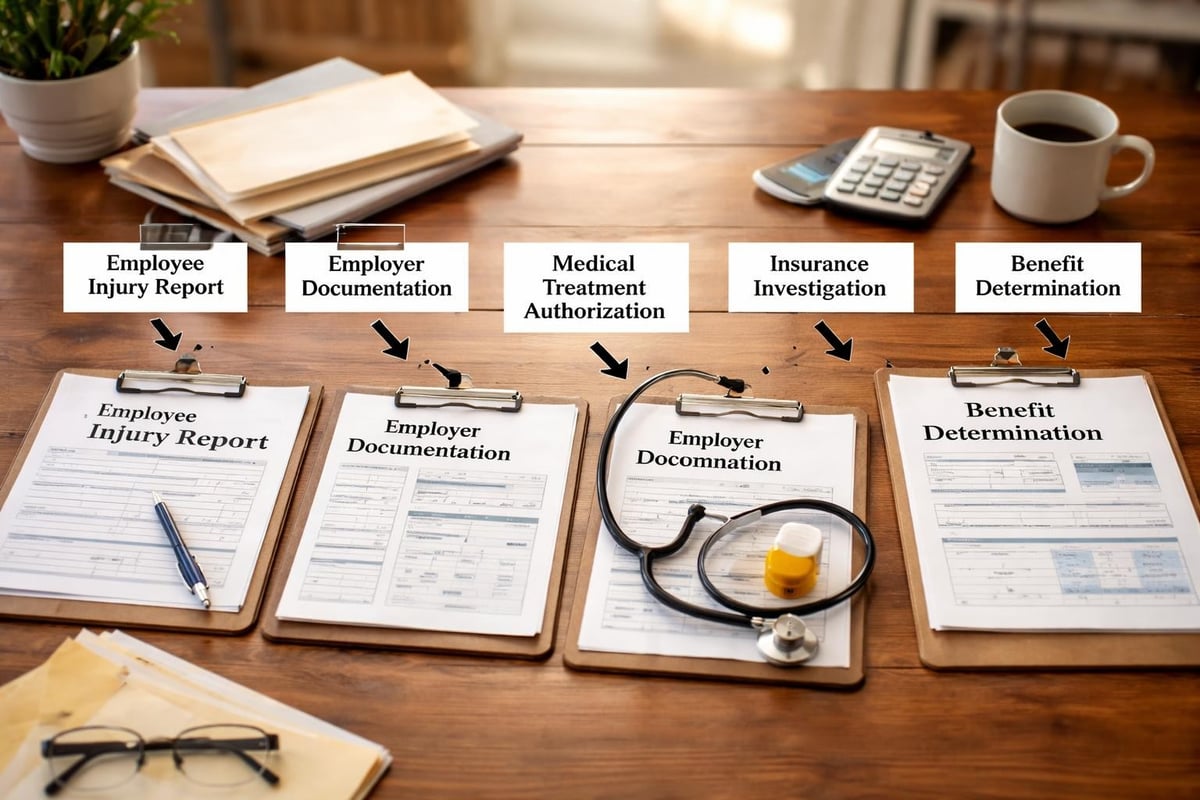
The Claims Process Step-by-Step
| Stage | Timeline | Key Actions |
|---|---|---|
| Injury occurs | Immediate | Employee reports injury to supervisor |
| Initial report | Within 24 hours | Employer completes incident documentation |
| Medical treatment | Within 48 hours | Employee receives approved medical care |
| Claim filing | Within 10 days | Insurer receives formal claim submission |
| Investigation | 14-30 days | Adjuster reviews circumstances and documentation |
| Determination | 30-60 days | Claim approved or denied with explanation |
The process starts when an employee reports an injury or illness they believe resulted from work activities. As the employer, you must immediately provide a claim form and report the incident to your insurance carrier. Minnesota law requires you to post information about workers compensation insurance rights prominently where all employees can access it.
Your insurance carrier assigns a claims examiner who investigates the incident, verifies employment status, and determines whether the injury qualifies for coverage. During this period, the injured worker receives medical treatment from approved providers, and the insurer begins processing wage replacement benefits if the employee misses work beyond the waiting period.
Common claim scenarios Minnesota businesses face:
- Slip and fall accidents in retail environments
- Repetitive stress injuries from manufacturing work
- Farm equipment-related injuries in agricultural operations
- Vehicle accidents during work-related travel
- Occupational illnesses from prolonged exposure to hazardous materials
The Insurance Journal’s workers compensation research shows that quick reporting and proper documentation significantly improve claim outcomes for both employees and employers.
Calculating Workers Compensation Costs for Minnesota Operations
Premium costs for insurance and workers compensation vary dramatically based on your industry, payroll, and claims history. Minnesota employers pay an average of $1.50 to $2.50 per $100 of payroll, though your actual rate depends on multiple factors.
Key Cost Determinants
Your industry classification code drives base rates significantly. Office workers might generate premiums around $0.50 per $100 of payroll, while construction roofers could face rates exceeding $15.00 per $100. This classification system reflects the statistical injury frequency and severity for different types of work.
Factors affecting your premium:
- Industry classification and associated risk level
- Total annual payroll across all employee categories
- Your company's claims history (experience modification rate)
- Safety programs and risk management initiatives
- Deductible selections and policy structure options
Minnesota uses an experience modification rate (EMR) that compares your claims history to similar businesses statewide. A 1.0 EMR represents average performance. Businesses with strong safety records earn credits with EMRs below 1.0, reducing premiums by 10-30%. Conversely, poor safety performance pushes your EMR above 1.0, increasing costs substantially.
For a typical small business in Minneapolis-St. Paul with 10 employees earning $40,000 annually and a moderate risk classification, annual workers compensation premiums might range from $6,000 to $12,000. However, a manufacturing operation in Duluth with similar payroll but higher-risk activities could pay $20,000 to $40,000 or more.
Premium Reduction Strategies
| Strategy | Potential Savings | Implementation Difficulty |
|---|---|---|
| Safety training programs | 5-15% | Low |
| Return-to-work programs | 10-25% | Medium |
| Workplace safety audits | 5-10% | Low |
| Claims management focus | 15-30% | Medium |
| Higher deductibles | 10-20% | Low |
Working with an independent broker like those at Guardian Insurance Services MN offices in Albany and Freeport allows you to compare quotes from multiple carriers, ensuring you receive competitive rates while maintaining comprehensive protection.
Essential Coverage Components Every Minnesota Employer Needs
Standard insurance and workers compensation policies include four primary coverage types that work together to protect your business and employees. Understanding these components helps you evaluate policy adequacy and identify potential gaps.
Medical Benefits
This coverage pays all reasonable and necessary medical expenses resulting from work-related injuries or illnesses. Minnesota requires unlimited lifetime medical benefits for covered conditions, distinguishing it from states with benefit caps. Medical coverage includes emergency treatment, hospital stays, surgery, prescription medications, physical therapy, and ongoing care for permanent conditions.
Your policy designates approved medical providers, though employees maintain some choice in selecting treating physicians. Directing injured workers to occupational medicine specialists often produces better outcomes and faster return-to-work timelines than general emergency room treatment.
Wage Replacement Benefits
When work injuries prevent employees from performing their duties, wage replacement kicks in after a three-day waiting period. Minnesota workers receive two-thirds of their average weekly wage, subject to state-mandated maximum and minimum amounts adjusted annually. For 2026, the maximum weekly benefit stands at $1,356.
Wage replacement categories include:
- Temporary total disability: Full work absence during recovery
- Temporary partial disability: Return to light duty at reduced earnings
- Permanent total disability: Inability to perform any gainful employment
- Permanent partial disability: Lasting impairment affecting earning capacity
These benefits continue until the worker reaches maximum medical improvement or returns to full employment capacity. Understanding these timelines helps Minnesota employers manage both employee expectations and operational planning.
Vocational Rehabilitation Services
When injuries prevent employees from returning to their previous roles, vocational rehabilitation services help them develop new skills for different employment. This coverage includes job retraining, education programs, job placement assistance, and adaptive equipment needs.
Minnesota's system emphasizes returning injured workers to productive employment rather than long-term benefit dependency. Employers who actively participate in rehabilitation planning often see better outcomes and reduced overall claim costs. The comprehensive approach to wc insurance coverage demonstrates how these systems balance multiple stakeholder interests.
Death Benefits
When workplace fatalities occur, workers compensation provides death benefits to surviving dependents. Minnesota pays weekly benefits to surviving spouses and children totaling two-thirds of the deceased worker's average weekly wage. Additionally, the policy covers burial expenses up to statutory limits, helping families manage immediate financial pressures during devastating circumstances.

Managing Claims to Control Long-Term Costs
Effective claims management represents the most powerful tool Minnesota employers have for controlling insurance and workers compensation expenses. Proactive strategies reduce both claim frequency and severity, directly impacting your experience modification rate and future premiums.
Immediate Response Protocols
The hours immediately following a workplace injury set the tone for the entire claims process. Train supervisors across your Minneapolis, St. Cloud, Rochester, or Duluth operations to respond consistently and compassionately when incidents occur.
- Provide immediate first aid while assessing injury severity
- Arrange appropriate medical care through approved providers
- Document incident details including witness statements and physical evidence
- Complete required forms within 24 hours of notification
- Contact your insurance carrier to initiate the claims process
- Communicate with the injured worker regularly throughout recovery
Your response demonstrates concern for employee wellbeing while protecting your business interests through proper documentation. Many disputed claims stem from inadequate initial reporting rather than actual coverage questions.
Return-to-Work Programs
Getting injured employees back to productive work-even in modified capacities-benefits everyone involved. Employees maintain connection to the workplace, preserve skills, and avoid the psychological challenges of extended absence. Employers reduce wage replacement costs and maintain productivity with experienced workers.
Effective return-to-work strategies include:
- Creating light-duty job inventories before injuries occur
- Maintaining regular contact with recovering employees
- Coordinating with treating physicians on work capacity
- Providing transitional assignments that accommodate restrictions
- Gradually increasing work hours and responsibilities
Minnesota businesses implementing formal return-to-work programs report 20-40% reductions in lost-time claim costs compared to organizations without these initiatives. This approach transforms insurance and workers compensation from purely protective spending into strategic workforce management.
Industry-Specific Considerations for Minnesota Businesses
Different industries face unique challenges with workers compensation coverage, requiring tailored approaches to both insurance selection and risk management. Understanding these distinctions helps Minnesota employers make informed decisions about their protection needs.
Agricultural Operations
Minnesota's strong agricultural sector, particularly in regions around Albany and Freeport, presents specific workers compensation challenges. Farm operations combine multiple high-risk activities including machinery operation, livestock handling, chemical application, and seasonal workload variations.
| Farm Activity | Relative Risk | Key Prevention Focus |
|---|---|---|
| Machinery operation | Very High | Training, maintenance, guards |
| Livestock handling | High | Proper facilities, handling techniques |
| Chemical application | High | PPE, ventilation, storage protocols |
| Manual labor | Moderate | Ergonomics, lifting techniques |
| Administrative work | Low | Standard office safety |
Many carriers offer specialized farm insurance packages that bundle workers compensation with property, liability, and equipment coverage. This integrated approach often provides better pricing and simplified management compared to purchasing separate policies.
Construction and Contracting
Construction trades face the highest workers compensation costs across Minnesota due to elevated injury risks. Roofing contractors, concrete workers, and demolition specialists routinely see rates exceeding $10-15 per $100 of payroll.
Beyond managing direct employees, general contractors must verify that all subcontractors carry valid workers compensation coverage. If a subcontractor lacks insurance, the general contractor becomes liable for their workers' injuries-a costly surprise that destroys project profitability. Certificate of insurance verification prevents these scenarios.
Manufacturing and Production
Minnesota's manufacturing sector, concentrated in the Twin Cities metro area and regional centers like St. Cloud and Rochester, combines repetitive motion risks with machinery hazards. Cumulative trauma claims from repetitive stress injuries often generate substantial long-term costs.
Prevention strategies should emphasize ergonomic workplace design, regular equipment maintenance, comprehensive safety training, and early intervention when employees report discomfort. The connection between general liability insurance and workers compensation becomes particularly important when manufacturing defects cause both employee injuries and third-party claims.
Professional Services
Office-based businesses around Minnesota enjoy the lowest workers compensation rates but shouldn't overlook coverage importance. Slip and fall accidents, ergonomic injuries from computer work, and stress-related conditions still generate legitimate claims requiring proper insurance protection.
Professional service firms also face unique considerations when employees work remotely or travel for client meetings. Ensuring your insurance and workers compensation policy properly covers these situations prevents coverage gaps that could leave you exposed to uninsured claim costs.
Selecting the Right Insurance Partner for Your Minnesota Business
Choosing where to purchase insurance and workers compensation coverage significantly impacts both your costs and claim experience. Minnesota employers have three primary options: state fund programs, direct insurance carriers, and independent insurance brokers.
State Fund vs. Private Insurance
Minnesota maintains a competitive state fund that provides workers compensation insurance alongside private carriers. This structure ensures coverage availability even for high-risk businesses that private insurers might decline.
State fund advantages:
- Guaranteed coverage availability regardless of risk profile
- Stable pricing without dramatic year-to-year fluctuations
- Simplified policy administration through single source
Private insurance benefits:
- Competitive pricing for lower-risk operations
- Broader coverage customization options
- Integrated business insurance packages
- Enhanced loss control and safety resources
Most Minnesota businesses benefit from comparing both state fund and private carrier options. Working with an independent broker provides access to multiple markets simultaneously, ensuring you identify the best value for your specific situation.
The Independent Broker Advantage
Independent insurance brokers represent your interests rather than a single insurance company's products. This distinction matters significantly when evaluating insurance and workers compensation options across Minnesota's diverse business landscape.
Brokers with access to 35+ insurance companies, like those available through general insurance agencies, can match your specific risk profile with carriers that specialize in your industry. A farm operation near Albany requires different expertise than a tech startup in Minneapolis or a retail operation in Duluth.
Key broker selection criteria:
- Experience with your specific industry and risk profile
- Access to multiple insurance carriers and markets
- Local presence for in-person consultations and service
- Claims advocacy support when disputes arise
- Proactive policy review and cost management guidance
The relationship extends beyond initial policy placement. Effective brokers provide ongoing service including annual coverage reviews, claims management assistance, safety program recommendations, and market monitoring to ensure continued competitive pricing.
Regulatory Compliance and Avoiding Penalties
Minnesota enforces workers compensation requirements aggressively, conducting regular compliance sweeps and investigating suspected violations. Understanding your obligations prevents costly penalties while protecting your business from uninsured exposure.
Posting and Notification Requirements
State law requires every Minnesota employer to post workers compensation information where employees can easily access it. These notices must include your insurance carrier's name and contact information, employee rights under the system, and procedures for reporting injuries.
You must also provide written notice to new employees about their workers compensation rights within the first week of employment. Maintaining documentation of these notifications protects you if disputes arise about whether workers understood their coverage.
Certificate Management
When hiring contractors or subcontractors, collecting and maintaining current certificates of insurance proves essential. These documents verify that contractors carry their own workers compensation coverage, preventing your policy from becoming responsible for their workers' injuries.
Best practices for certificate management:
- Request certificates before work begins on any project
- Verify certificate authenticity with the listed insurance carrier
- Confirm coverage dates encompass the entire project timeline
- Maintain organized filing systems for quick retrieval during audits
- Set calendar reminders to request updated certificates before expiration
Many Minnesota contractors have learned this lesson the hard way after insurance audits revealed uncovered subcontractor payroll, generating five or six-figure premium charges for completed projects.
Audit Preparation
Annual premium audits verify that you paid appropriate amounts based on actual payroll and employee classifications. Insurance carriers conduct these audits within weeks of your policy anniversary, reviewing payroll records, tax filings, and contractor documentation.
Preparation steps include organizing complete payroll records, documenting independent contractor relationships, properly classifying employees by job duties, and maintaining certificates of insurance for all subcontractors. The California Commission on Health and Safety and Workers’ Compensation provides research showing how proper classification and documentation practices benefit both employers and insurance systems.
Integrating Workers Compensation with Broader Risk Management
Smart Minnesota businesses view insurance and workers compensation as one component within comprehensive risk management rather than an isolated requirement. This integrated perspective produces better outcomes across multiple dimensions.
Coordinating Multiple Coverage Types
Workers compensation interacts with several other business insurance policies, creating potential overlaps and gaps that require careful coordination. For instance, commercial auto insurance may cover vehicle accident injuries, but workers compensation applies when employees drive for business purposes.
Coverage coordination points:
- Auto liability vs. workers compensation for driving employees
- General liability vs. workers compensation for workplace injuries
- Employee benefits integration with disability coverage
- Umbrella liability enhancement of workers compensation limits
- Commercial property insurance coordination for workplace safety
Reviewing these intersections with experienced insurance professionals prevents coverage gaps while eliminating unnecessary duplicative coverage that wastes premium dollars.
Safety Culture Development
The most effective cost control strategy for insurance and workers compensation involves preventing injuries before they occur. Minnesota businesses that cultivate strong safety cultures enjoy dramatically lower claim rates and associated insurance costs.
Safety culture extends beyond compliance with OSHA regulations to create workplace environments where employees actively participate in hazard identification and risk reduction. This transformation requires leadership commitment, resource allocation, and sustained effort over time.
Regular safety meetings, near-miss reporting systems, employee safety committees, equipment maintenance protocols, and recognition programs for safe performance all contribute to cultural change. Businesses investing in these initiatives typically see 30-50% claim frequency reductions within two to three years.
Data-Driven Decision Making
Modern workers compensation programs generate extensive data about injury patterns, cost drivers, and prevention opportunities. Minnesota employers who analyze this information make better risk management decisions than those treating insurance as a passive expense.
Review quarterly loss runs showing individual claims, identified injury patterns by department or job role, claim costs broken down by medical vs. indemnity expenses, and reserve changes indicating claim development trends. This analysis reveals specific focus areas for safety improvements and helps justify prevention program investments to company leadership.
Understanding insurance and workers compensation requirements represents a fundamental responsibility for every Minnesota employer, protecting both your workforce and your business from devastating financial consequences. From navigating state regulations and selecting appropriate coverage to managing claims effectively and building prevention programs, the decisions you make about workers compensation directly impact your operational success and employee wellbeing. Whether your business operates in Albany, Freeport, or anywhere across Minnesota, Guardian Insurance Services MN brings over 35 insurance carrier options and local expertise to help you secure the right protection at competitive rates. Reach out today to discuss your specific workers compensation needs and discover how independent insurance brokerage services can strengthen your business protection strategy.