
Running a plumbing business in Minnesota requires more than just technical expertise and quality service. Protecting your business with the right insurance coverage is essential to your long-term success and financial security. Whether you're a solo plumber in Minneapolis or managing a team of technicians across St. Paul and Rochester, understanding plumbing insurance cost is critical for budgeting and ensuring you have adequate protection. The investment in proper insurance coverage can mean the difference between a minor setback and a business-ending catastrophe. This comprehensive guide breaks down everything Minnesota plumbing contractors need to know about insurance costs, coverage options, and strategies to get the best protection for your investment.
Understanding Plumbing Insurance Fundamentals
Plumbing insurance cost varies significantly based on numerous factors specific to your business operations. The insurance industry doesn't use a one-size-fits-all approach when calculating premiums for plumbing contractors. Instead, insurance underwriters evaluate multiple risk factors to determine your specific rate.
What Plumbing Insurance Actually Covers
Professional plumbing contractors need several types of coverage to fully protect their operations:
- General Liability Insurance: Protects against third-party bodily injury and property damage claims
- Workers' Compensation: Required in Minnesota for most businesses with employees
- Commercial Auto Insurance: Covers work vehicles and equipment transportation
- Tools and Equipment Coverage: Protects your specialized plumbing tools and machinery
- Professional Liability: Covers errors and omissions in your professional services
- Commercial Property Insurance: Protects your physical business location and inventory
Understanding commercial general liability insurance coverage is particularly important since this forms the foundation of most plumbing insurance packages. This coverage responds when clients or third parties claim your work caused damage or injury.

Average Premium Ranges for Minnesota Plumbers
According to detailed insurance cost analyses, plumbing contractors typically see these premium ranges:
| Coverage Type | Annual Cost Range | Typical Coverage Limits |
|---|---|---|
| General Liability | $500 – $3,000 | $1M per occurrence / $2M aggregate |
| Workers' Compensation | $2,000 – $10,000+ | Statutory limits |
| Commercial Auto | $1,200 – $2,500 per vehicle | $1M combined single limit |
| Tools & Equipment | $300 – $1,500 | $25,000 – $100,000 |
| Professional Liability | $800 – $2,500 | $1M per claim |
These figures represent typical costs for small to medium-sized plumbing operations in Minnesota. Your actual plumbing insurance cost will depend on your specific circumstances and risk profile.
Key Factors That Determine Your Insurance Premiums
Multiple variables influence what you'll pay for coverage. Insurance companies analyze your business from every angle to assess risk accurately.
Business Size and Revenue
The size of your operation dramatically impacts your premiums. A solo plumber working out of Duluth will pay significantly less than a company with 20 employees serving the entire Twin Cities metro area. Annual revenue serves as a key rating factor because higher revenue typically correlates with more jobs, more exposure, and consequently more risk.
Most insurers use your gross annual receipts to calculate base premiums. A plumbing contractor generating $150,000 annually might pay $1,200 for general liability, while a business with $1.5 million in revenue could pay $4,000 or more for similar coverage limits.
Employee Count and Payroll
Workers’ comp insurance coverage costs directly correlate with your payroll and the number of employees. Minnesota requires most employers to carry workers' compensation insurance, and plumbing ranks as a moderately high-risk occupation.
The state uses classification codes to determine rates:
- Plumbing contractors typically fall under code 5183
- Rates vary based on your claims history and experience modification factor
- Annual payroll determines the premium base calculation
A plumber with three employees and $180,000 in annual payroll might expect to pay $5,400 annually for workers' compensation, though this varies based on individual experience ratings.
Location and Service Area
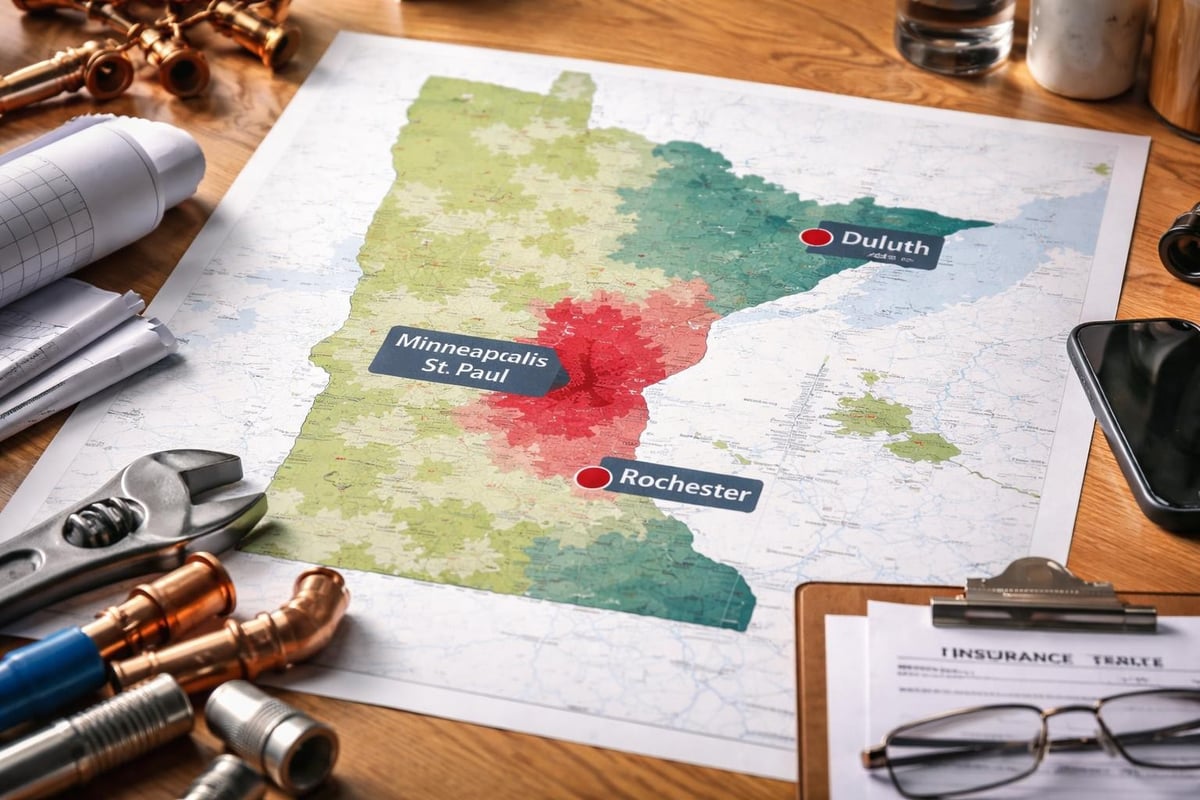
Your primary business location and service area within Minnesota affect your plumbing insurance cost. Urban areas like Minneapolis, St. Paul, and Bloomington typically have higher rates due to:
- Increased traffic congestion and accident risks
- Higher property values and potential damage costs
- Greater litigation frequency in metropolitan areas
- More regulatory oversight and compliance requirements
Conversely, plumbers operating primarily in Rochester, St. Cloud, or rural Minnesota counties often enjoy lower premiums. The competitive insurance market in Minnesota means working with an independent broker can help you find better rates regardless of your location.
Claims History and Experience
Your track record matters tremendously. Insurance companies reward contractors who demonstrate safe operations and effective risk management. If you've maintained a clean claims history for three to five years, you'll qualify for significantly better rates.
The experience modification rate (EMR or MOD) specifically impacts your workers' compensation premiums. An EMR of 1.0 represents average risk, while scores below 1.0 indicate better-than-average safety records and earn discounts. Scores above 1.0 result in surcharges.
Coverage Options and Customization
Smart plumbing contractors don't just buy the minimum required coverage. They strategically build insurance programs that protect against their specific exposures.
Essential Coverage Combinations
According to specialized plumbing insurance resources, most successful plumbing businesses carry these coverage combinations:
Basic Protection Package:
- General liability ($1M/$2M limits)
- Commercial auto (required by law)
- Workers' compensation (if you have employees)
Comprehensive Protection Package:
- All basic coverages with higher limits
- Tools and equipment coverage
- Professional liability insurance
- Umbrella or excess liability ($1M-$5M)
- Business interruption coverage
The comprehensive approach costs more upfront but provides substantially better protection. A water damage claim from a failed pipe installation could easily exceed $1 million in total costs when you factor in repairs, temporary housing, business interruption, and legal fees.
Understanding Deductibles and Their Impact
Your deductible choice significantly affects your plumbing insurance cost. Higher deductibles reduce premiums but increase out-of-pocket expenses when you file claims.
| Deductible Amount | Premium Impact | Best For |
|---|---|---|
| $500 | Highest premiums | Minimal financial reserves |
| $1,000 | Moderate premiums | Average risk tolerance |
| $2,500 | Lower premiums | Strong cash reserves |
| $5,000+ | Lowest premiums | Excellent financial position |
Many Minnesota plumbers choose $1,000 deductibles as a balance between affordable premiums and manageable out-of-pocket costs. Working with insurance brokers in Minnesota helps you analyze the optimal deductible based on your financial situation.
Additional Coverage Endorsements
Beyond standard policies, consider these valuable endorsements:
- Pollution Liability: Covers environmental contamination from sewage or chemical spills
- Cyber Liability: Protects against data breaches if you store customer information
- Employee Dishonesty: Covers theft by employees
- Hired and Non-Owned Auto: Extends coverage to rental vehicles and employee personal vehicles used for business
Each endorsement adds to your total plumbing insurance cost but fills important coverage gaps. A comprehensive commercial insurance for business approach ensures you're not left exposed to unforeseen risks.
Strategies to Reduce Your Insurance Costs
While insurance is a necessary business expense, you don't have to overpay. Strategic planning and risk management can substantially reduce your premiums.
Implement Comprehensive Safety Programs
Insurance companies reward proactive safety measures with premium discounts ranging from 5% to 25%. Effective safety programs for plumbing contractors include:
- Regular safety training and certification updates
- Documented safety meetings and toolbox talks
- Written safety policies and procedures
- Drug and alcohol testing programs
- New employee orientation protocols
- Incident investigation and corrective action systems
Minnesota plumbers who demonstrate commitment to safety through formal programs often qualify for preferred pricing tiers. Document everything – insurers want proof of your safety culture, not just promises.
Bundle Multiple Policies
Purchasing all your coverage from one carrier or through one broker typically results in multi-policy discounts. Bundling general liability, commercial auto, workers' compensation, and property coverage can reduce your total plumbing insurance cost by 10% to 20%.
Independent brokers have access to multiple insurance companies for business insurance, allowing them to package coverage from different carriers when beneficial. This flexibility ensures you get optimal pricing without sacrificing coverage quality.
Maintain Excellent Credit and Financial Stability
Business credit scores increasingly influence insurance pricing. Insurers correlate strong financial management with lower claims frequency. Maintaining excellent credit can save you 15% or more on premiums.
Steps to improve your insurance-related credit profile:
- Pay all bills on time, especially insurance premiums
- Keep debt levels manageable relative to revenue
- Maintain strong cash reserves
- Document financial stability through regular accounting
- Avoid tax liens and legal judgments
Choose Higher Liability Limits Strategically
This seems counterintuitive, but increasing liability limits from $1M to $2M per occurrence often costs just 10-20% more in premium. However, adding umbrella coverage above your base limits provides even better value – $1M in umbrella coverage typically costs $400-$800 annually.
For comprehensive protection against catastrophic claims, consider this structure:
- Base general liability: $1M per occurrence / $2M aggregate
- Commercial umbrella: $2M additional
- Total protection: $3M for major incidents
This approach provides superior protection without dramatically increasing your plumbing insurance cost.

Navigating Minnesota-Specific Requirements
Understanding state-specific regulations ensures you maintain compliance while optimizing costs.
Minnesota Workers' Compensation Requirements
Minnesota law requires workers' compensation coverage for most employers. The state's Department of Labor and Industry oversees compliance. Penalties for non-compliance include fines up to $25,000 and potential criminal charges.
Minnesota-specific considerations:
- Independent contractors vs. employees (proper classification matters)
- Family member exemptions (spouses and certain relatives may be exempt)
- Coverage requirements kick in with the first employee
- State fund availability if you can't find commercial coverage
Working with brokers familiar with WC insurance coverage in Minnesota ensures you meet all state requirements while finding competitive rates.
Licensing and Bond Requirements
Minnesota plumbing contractors must maintain:
- State plumbing license (Master or Journeyman level)
- Local business licenses where applicable
- Contractor bonds (amounts vary by jurisdiction)
- Proof of insurance for commercial contracts
Some municipalities in Minnesota require proof of minimum insurance coverage before issuing permits. Minneapolis, St. Paul, and Rochester commonly require contractors to demonstrate $1M in general liability coverage for larger projects.
Commercial Vehicle Requirements
Minnesota requires commercial auto insurance for business vehicles. Understanding how homeowners insurance handles various scenarios differs from commercial needs – your personal auto policy won't cover business use.
Minimum commercial auto requirements in Minnesota:
- $30,000 bodily injury per person
- $60,000 bodily injury per accident
- $10,000 property damage
However, these minimums provide inadequate protection. Most plumbing contractors should carry at least $1M combined single limit coverage. The incremental cost difference between minimum and adequate coverage is minimal compared to the protection gap.
Working With Independent Insurance Brokers
The complexity of plumbing insurance makes professional guidance valuable. Independent brokers offer distinct advantages over captive agents or direct purchase options.
Advantages of Independent Representation
Independent brokers access multiple carriers and can compare coverage and pricing across dozens of options. This competition works in your favor, potentially reducing your plumbing insurance cost by 15-30% compared to single-carrier quotes.
Key benefits include:
- Market access to 35+ insurance carriers
- Objective advice without carrier bias
- Claims advocacy when issues arise
- Annual policy reviews and remarketing
- Expertise in construction and contracting insurance
Questions to Ask Your Insurance Broker
When evaluating insurance options for your plumbing business, ask these critical questions:
- What specific exclusions exist in this policy?
- How does the claims process work, and what documentation is required?
- Are subcontractors covered under my policy, or do they need their own?
- What safety certifications or programs could reduce my premium?
- How does my coverage compare to industry standards for similar businesses?
Experienced brokers specializing in contractors insurance near Minneapolis and St. Paul understand the unique risks plumbers face and can structure policies accordingly.
Annual Review and Policy Shopping
Your insurance needs evolve as your business grows. Annual policy reviews identify coverage gaps and optimization opportunities. Schedule these reviews 60-90 days before renewal to allow adequate time for market comparison.
During reviews, discuss:
- Revenue changes and projections
- Employee count fluctuations
- New service offerings or equipment
- Claims experience over the past year
- Coverage adequacy based on current contracts
Remarketing your insurance every 2-3 years ensures you maintain competitive pricing. The insurance market constantly fluctuates, and loyalty doesn't always reward contractors with the best rates.
Real-World Cost Examples for Minnesota Plumbers
Understanding theoretical costs helps, but real examples provide practical context for budgeting.
Solo Plumber Example
Business Profile:
- Location: St. Cloud, Minnesota
- One licensed plumber, no employees
- Annual revenue: $125,000
- Two service vehicles
- Primarily residential service and repair
Estimated Annual Insurance Costs:
| Coverage Type | Annual Premium |
|---|---|
| General Liability ($1M/$2M) | $650 |
| Commercial Auto (2 vehicles) | $2,200 |
| Tools & Equipment ($35,000) | $425 |
| Professional Liability | $900 |
| Total Annual Cost | $4,175 |
This represents approximately 3.3% of annual revenue – a reasonable insurance investment for comprehensive protection.
Small Plumbing Company Example
Business Profile:
- Location: Rochester, Minnesota
- One owner, five employees
- Annual revenue: $850,000
- Annual payroll: $300,000
- Mix of residential and commercial projects
Estimated Annual Insurance Costs:
| Coverage Type | Annual Premium |
|---|---|
| General Liability ($2M/$4M) | $2,400 |
| Workers' Compensation | $7,800 |
| Commercial Auto (4 vehicles) | $4,200 |
| Tools & Equipment ($75,000) | $950 |
| Professional Liability | $1,650 |
| Commercial Property | $1,200 |
| Umbrella ($2M) | $750 |
| Total Annual Cost | $18,950 |
This totals approximately 2.2% of annual revenue. The larger operation benefits from economies of scale, resulting in a lower percentage cost despite higher absolute premiums.
Growing Plumbing Contractor Example
Business Profile:
- Location: Minneapolis-St. Paul metro area
- Two licensed plumbers, twelve total employees
- Annual revenue: $2,100,000
- Annual payroll: $950,000
- Commercial and industrial projects
Estimated Annual Insurance Costs:
| Coverage Type | Annual Premium |
|---|---|
| General Liability ($2M/$4M) | $5,200 |
| Workers' Compensation | $18,500 |
| Commercial Auto (8 vehicles) | $9,600 |
| Tools & Equipment ($150,000) | $1,850 |
| Professional Liability | $3,200 |
| Commercial Property | $2,400 |
| Umbrella ($5M) | $1,650 |
| Pollution Liability | $2,100 |
| Total Annual Cost | $44,500 |
At approximately 2.1% of revenue, this comprehensive program provides extensive protection appropriate for larger contract values and higher risk exposure.
Common Insurance Mistakes Plumbing Contractors Make
Avoiding these frequent errors protects your business and optimizes your plumbing insurance cost.
Underinsuring to Save Money
The cheapest coverage isn't always the best value. Purchasing minimum limits or excluding important coverage options leaves you financially exposed. A single major claim can bankrupt an underinsured business.
Consider the real cost of inadequate coverage:
- $1M general liability limit exhausted by single water damage claim
- Lawsuit defense costs ($150-$500 per hour) depleting policy limits
- Personal assets at risk when business coverage proves insufficient
- Potential business closure due to uninsured catastrophic loss
Smart contractors balance premium costs against appropriate protection levels. According to detailed guides on plumbing insurance, most claims fall within standard policy limits, but the catastrophic ones justify higher coverage investment.
Failing to Update Coverage Annually
Your business changes throughout the year – your insurance should reflect that reality. Notify your broker immediately about significant changes:
- Adding employees (affects workers' comp and liability premiums)
- Purchasing new vehicles or equipment
- Expanding service areas or adding new service types
- Taking on larger contracts or commercial work
- Opening additional locations
Waiting until renewal to report changes can result in coverage gaps or retroactive premium charges. Mid-term policy updates ensure continuous appropriate protection.
Misclassifying Workers
Treating employees as independent contractors to avoid workers' compensation costs creates enormous liability exposure. Minnesota aggressively audits worker classification, and misclassification results in:
- Retroactive workers' comp premiums plus penalties
- Potential fines from the Department of Labor
- Tax penalties and interest charges
- Litigation from injured workers
- Damage to business reputation
The modest premium savings aren't worth the catastrophic downside risk. Properly classify all workers and maintain appropriate coverage.
Ignoring Cyber and Data Risks
Modern plumbing businesses store customer information electronically – names, addresses, payment data, and service history. Data breaches affect businesses of all sizes, not just large corporations.
A single laptop theft containing customer data could trigger:
- Notification requirements under Minnesota data breach laws
- Credit monitoring services for affected customers ($20-30 per person)
- Legal defense costs
- Regulatory fines
- Reputation damage
Cyber liability coverage costs $500-$1,500 annually for small plumbing contractors – a minimal investment against potentially devastating exposure.
Planning for Long-Term Insurance Success
Strategic insurance management supports sustainable business growth and financial stability.
Building a Risk Management Culture
Insurance is just one component of comprehensive risk management. Successful plumbing contractors implement systematic approaches to identifying, evaluating, and controlling risks.
Effective risk management practices include:
- Regular safety training and certification updates
- Quality control procedures for all installations
- Written contracts clearly defining scope and responsibilities
- Systematic documentation of all jobs (photos, notes, communications)
- Prompt response to customer concerns and complaints
- Maintenance programs for vehicles and equipment
These practices not only reduce claims but also strengthen your position if claims do occur. Insurance companies recognize and reward comprehensive risk management through better pricing and terms.
Creating Insurance Budgets and Reserves
Treat insurance as a predictable, budgeted business expense rather than an annual surprise. Build insurance costs into your pricing structure to ensure adequate recovery through your rates.
Calculate your fully loaded hourly rate including:
- Direct labor costs
- Overhead (including insurance)
- Equipment depreciation
- Desired profit margin
For the small company example earlier, $18,950 in annual insurance across 2,080 billable hours equals approximately $9.11 per hour in insurance cost. This must be built into your pricing to maintain profitability.
Additionally, maintain cash reserves for deductibles and any self-insured exposures. Financial strength provides flexibility during challenging times and demonstrates stability to insurance underwriters.
Leveraging Technology and Documentation
Modern insurance companies increasingly reward contractors who leverage technology for safety and quality control. Investment in business systems can directly reduce your plumbing insurance cost.
Beneficial technologies include:
- GPS tracking and telematics for vehicles (proves safe driving)
- Digital inspection and documentation tools (supports claims defense)
- Customer relationship management systems (tracks communications)
- Accounting software (demonstrates financial stability)
- Safety management platforms (documents training and compliance)
These tools cost money upfront but generate returns through efficiency gains, reduced claims, and lower insurance premiums. The documentation created becomes invaluable if you ever face claims or litigation.
Understanding plumbing insurance cost empowers you to make informed decisions that protect your business while managing expenses effectively. The investment in appropriate coverage safeguards everything you've built and provides peace of mind as you grow your Minnesota plumbing operation. Whether you're just starting out in Duluth or managing an established team across the Twin Cities, Guardian Insurance Services MN brings decades of experience helping contractors find optimal coverage from over 35 top insurance companies. Our locally owned team in Albany and Freeport understands the unique challenges Minnesota plumbers face and delivers personalized service to match your specific needs with the right protection at competitive rates.