
Finding the right health coverage starts with understanding how to obtain and evaluate insurance quotes for health insurance effectively. Whether you're a small business owner in Albany seeking employee benefits or a Freeport family looking for individual coverage, knowing how to navigate the quote process can save you thousands of dollars annually while ensuring you get comprehensive protection. The health insurance landscape in Minnesota offers numerous options, and getting accurate quotes is your first step toward making an informed decision that protects both your health and your financial future.
Understanding Insurance Quotes for Health Insurance
Insurance quotes for health insurance represent estimated costs based on your specific circumstances, health needs, and coverage preferences. These quotes aren't random numbers pulled from thin air – they're calculated using sophisticated algorithms that consider dozens of factors unique to you and your situation.
Premium calculations take into account:
- Your age and family composition
- Geographic location within Minnesota
- Tobacco usage status
- Plan type and coverage level
- Deductible and out-of-pocket maximum selections
- Network size and provider access
When you request insurance quotes for health insurance, you're essentially asking carriers to evaluate your risk profile and determine what they'll charge for assuming responsibility for your medical expenses. This process has become significantly more standardized since the Affordable Care Act, but substantial variation still exists between carriers and plan designs.
Key Components Every Quote Should Include
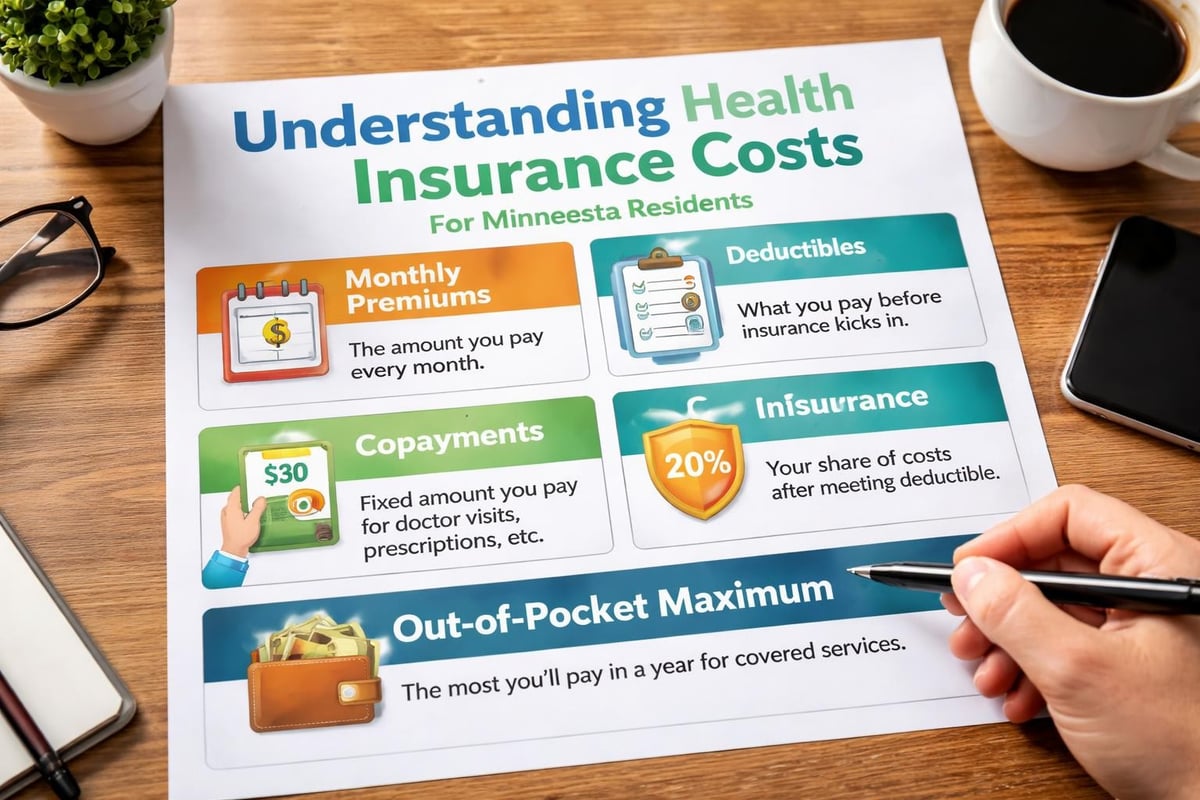
Every legitimate health insurance quote must provide clear information about several critical elements. Understanding these components helps you make apples-to-apples comparisons when evaluating multiple options.
| Component | What It Means | Why It Matters |
|---|---|---|
| Monthly Premium | Amount you pay regardless of care usage | Determines your fixed monthly budget |
| Annual Deductible | What you pay before insurance kicks in | Affects your upfront cost exposure |
| Out-of-Pocket Maximum | Highest amount you'll pay annually | Protects against catastrophic costs |
| Copayments | Fixed fees for specific services | Impacts routine care affordability |
| Coinsurance | Percentage you pay after deductible | Determines cost-sharing structure |
The health insurance landscape continues evolving, making it essential to understand how each component affects your total healthcare spending throughout the year.
How to Obtain Accurate Insurance Quotes for Health Insurance
Getting accurate quotes requires providing complete and truthful information. Incomplete applications lead to misleading quotes that change dramatically when you actually apply for coverage.
Gathering Required Information
Before requesting insurance quotes for health insurance, compile essential documentation and personal details. This preparation streamlines the quote process and ensures accuracy from the start.
You'll need:
- Social Security numbers for all family members seeking coverage
- Income documentation including W-2s, pay stubs, or tax returns
- Current prescription medications with dosages and frequencies
- Existing health conditions and treatment histories
- Preferred doctors and medical facilities in Minneapolis, St. Cloud, or surrounding areas
Minnesota residents have access to state-specific resources that provide detailed information about coverage options unique to our region. These guides help you understand what questions to expect when obtaining quotes.
Comparing Multiple Quote Sources
Smart consumers obtain insurance quotes for health insurance from multiple sources to ensure they're seeing the full market. Working with an independent broker like Guardian Insurance Services MN gives you access to over 35 carriers simultaneously, dramatically expanding your options beyond what you'd find going directly to individual companies.
Quote sources include:
- Independent insurance brokers with multi-carrier access
- Direct carrier websites and phone lines
- Government marketplaces (MNsure for Minnesota)
- Employer-sponsored plan options
- Professional association group plans
Each source has advantages and limitations. Independent brokers provide personalized guidance without favoring any single carrier, while direct channels may offer promotional rates not available elsewhere.
Factors That Influence Your Health Insurance Quotes
Understanding what drives quote variations helps you make strategic decisions about coverage levels and plan designs. Some factors you can control, while others remain fixed regardless of your preferences.
Age and Geographic Location
Your age represents the single largest modifiable factor in health insurance pricing. Older individuals face significantly higher premiums due to increased utilization patterns and higher-cost medical services.
In Minnesota, location affects pricing based on regional healthcare costs. Rochester's Mayo Clinic proximity creates different cost structures than rural Stearns County where Albany and Freeport residents live. These geographic variations can create premium differences of 15-30% for identical coverage.
Tobacco Use and Health Status
Tobacco users can face surcharges up to 50% higher than non-tobacco users when getting insurance quotes for health insurance. This significant penalty reflects the well-documented health consequences and increased medical costs associated with smoking and tobacco products.
While pre-existing conditions can no longer result in coverage denials or direct premium increases thanks to ACA protections, they do influence which plan designs make the most financial sense for your situation.

Understanding Metal Tier Plans and Their Impact on Quotes
When comparing insurance quotes for health insurance, you'll encounter Bronze, Silver, Gold, and Platinum classifications. These metal tiers represent different cost-sharing arrangements between you and your insurance carrier.
How Metal Tiers Work
| Tier | Insurer Pays | You Pay | Best For |
|---|---|---|---|
| Bronze | ~60% | ~40% | Healthy individuals, catastrophic protection |
| Silver | ~70% | ~30% | Moderate care needs, subsidy eligibility |
| Gold | ~80% | ~20% | Regular care needs, prescription users |
| Platinum | ~90% | ~10% | High utilization, chronic conditions |
Bronze plans offer the lowest monthly premiums but highest out-of-pocket costs when you need care. Platinum plans flip that equation, charging higher premiums but providing more comprehensive coverage when you visit doctors or fill prescriptions.
For many Minnesota families, Silver plans represent the sweet spot, especially if you qualify for cost-sharing reductions through MNsure. These subsidies only apply to Silver tier plans and can dramatically reduce your deductibles and out-of-pocket maximums beyond the premium tax credits.
Matching Plans to Your Healthcare Needs
Getting the right insurance quotes for health insurance means honestly assessing your expected healthcare utilization. Look at last year's medical expenses, upcoming procedures, ongoing prescriptions, and your comfort level with financial risk.
Consider a higher-tier plan if you:
- Take multiple daily medications
- Have chronic conditions requiring specialist care
- Plan elective procedures or surgeries
- Prefer predictable costs over premium savings
- Have young children with frequent pediatric visits
Consider a lower-tier plan if you:
- Rarely visit doctors beyond annual checkups
- Maintain excellent health with no chronic conditions
- Can afford potential high deductibles if emergencies arise
- Want to maximize HSA contributions with HDHP plans
- Prioritize monthly budget over coverage richness
The comprehensive insurance coverage resources available through experienced brokers help you navigate these complex decisions with confidence.
Network Considerations in Health Insurance Quotes
Your provider network dramatically impacts both your quoted premiums and your actual out-of-pocket costs. Understanding network types helps you evaluate whether lower-premium plans actually save money or just shift costs elsewhere.
HMO vs. PPO vs. EPO Networks
Health Maintenance Organizations (HMOs) require primary care physician selection and referrals for specialist care. They offer lower premiums but less flexibility. In central Minnesota, this might mean choosing between CentraCare and other regional health systems as your primary network.
Preferred Provider Organizations (PPOs) provide more flexibility, allowing specialist visits without referrals and offering partial out-of-network coverage. You'll pay higher premiums for this freedom, but gain access to broader provider pools including Mayo Clinic facilities or Twin Cities specialists.
Exclusive Provider Organizations (EPOs) blend elements of both, offering no out-of-network coverage except emergencies but eliminating referral requirements. These plans often present attractive insurance quotes for health insurance while maintaining reasonable network sizes.
Verifying Provider Participation
Before accepting any quote, verify your preferred doctors, hospitals, and specialists participate in that specific plan's network. Provider directories change frequently, and last year's network might not reflect current participation.
Verification steps:
- Download the current provider directory from the insurer
- Call your doctors' offices to confirm participation
- Verify hospital affiliations match your preferences
- Check prescription formularies for your medications
- Confirm specialist access for ongoing treatments
This due diligence prevents unpleasant surprises when you need care and discover your longtime physician no longer accepts your new insurance.
Subsidies and Tax Credits Impact on Quotes
Many Minnesota residents qualify for financial assistance that dramatically reduces their actual health insurance costs below the initial quoted premiums. Understanding subsidy eligibility transforms how you evaluate insurance quotes for health insurance.
Premium Tax Credits
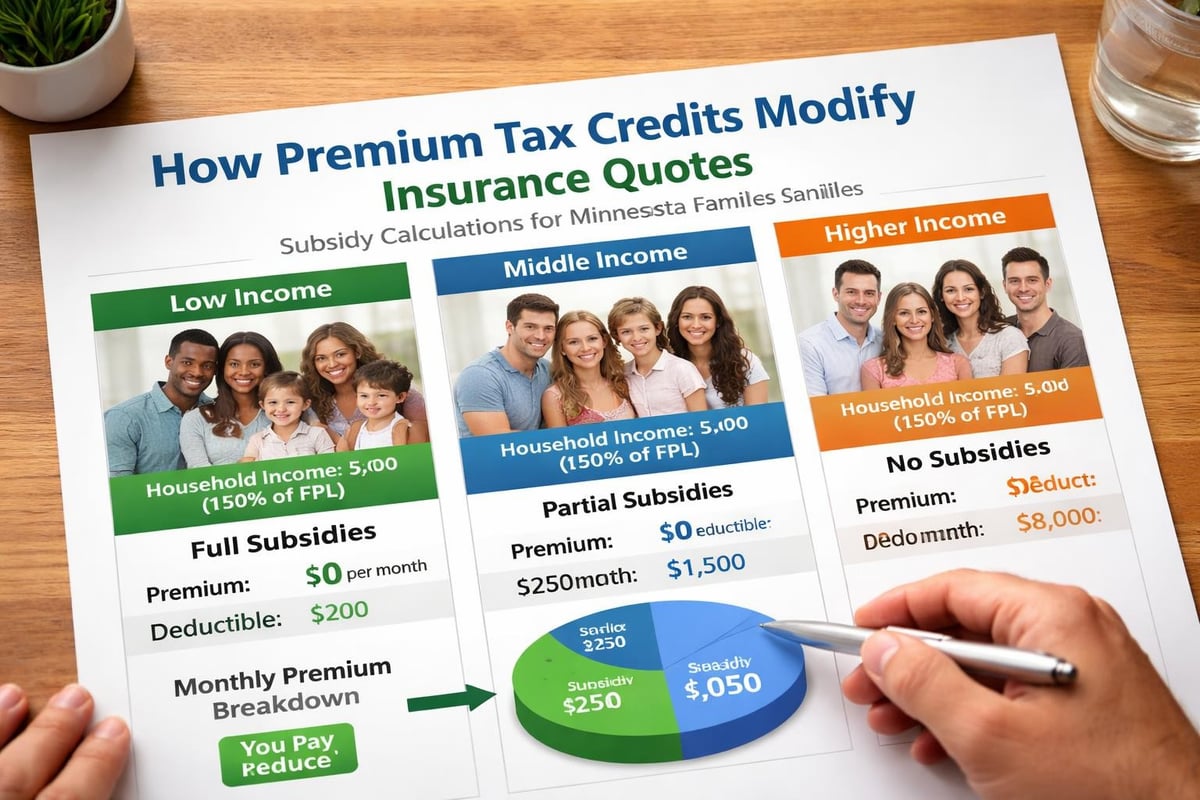
Premium tax credits apply directly to your monthly insurance bills, reducing what you actually pay. These credits scale based on your household income relative to the federal poverty level, with most assistance concentrated between 100% and 400% FPL.
For a family of four in Minnesota earning $75,000 annually, premium tax credits might reduce monthly costs by $500-800 depending on the plan selected. This transforms a $1,200 monthly premium into a $400-700 actual expense, making comprehensive coverage affordable for middle-class families.
Cost-Sharing Reductions
Cost-sharing reductions (CSRs) work differently than premium credits. They reduce your deductibles, copayments, and out-of-pocket maximums, but only apply to Silver tier plans purchased through MNsure.
CSR eligibility levels:
- 94% coverage for households under 150% FPL
- 87% coverage for households 150-200% FPL
- 73% coverage for households 200-250% FPL
These subsidies can transform a standard Silver plan with a $5,000 deductible into enhanced coverage with a $500 deductible, making healthcare genuinely accessible rather than nominally "covered."
Common Mistakes When Comparing Health Insurance Quotes
Even experienced consumers make critical errors when evaluating insurance quotes for health insurance. Avoiding these pitfalls ensures you select coverage that truly meets your needs without unexpected gaps or excessive costs.
Focusing Solely on Premium Costs
The lowest-premium plan frequently becomes the highest-cost option when you actually need healthcare. A plan charging $200 monthly with a $8,000 deductible costs far more than a $450 monthly plan with a $2,000 deductible if you face any significant medical needs.
Calculate total potential costs:
- Annual premiums (monthly premium × 12)
- Expected routine care costs
- Prescription medication expenses
- Worst-case scenario (out-of-pocket maximum)
- Tax advantages for HSA-eligible plans
This comprehensive view reveals your true financial exposure rather than just your monthly budget impact.
Ignoring Prescription Drug Coverage
Prescription coverage varies dramatically between plans, even within the same metal tier. Some medications fall into specialty tiers with 30-40% coinsurance, creating monthly costs of hundreds or thousands of dollars.
Before finalizing any health insurance decision, verify your specific medications appear on the plan's formulary and identify which tier they occupy. The most attractive insurance quotes for health insurance become irrelevant if your essential medications face prohibitive cost-sharing.
Overlooking Annual Plan Changes
Health insurance isn't a set-it-and-forget-it decision. Networks change, formularies update, and premiums adjust annually. What worked perfectly in 2025 might become inadequate or overpriced for 2026.
Successful health insurance consumers review their coverage annually during open enrollment, obtaining fresh insurance quotes for health insurance even if they're satisfied with current coverage. This discipline ensures you're always getting optimal value and appropriate protection as your circumstances evolve.
Working with Independent Insurance Brokers
Independent brokers provide significant advantages when shopping for health coverage. Unlike captive agents representing single carriers, independent brokers access multiple insurance companies simultaneously, presenting you with comprehensive market views rather than limited selections.
Benefits of Broker Relationships
Professional guidance includes:
- Objective plan comparisons across 35+ carriers
- Subsidy eligibility calculations and optimization
- Network adequacy verification for your providers
- Ongoing support during claims or coverage questions
- Annual reviews ensuring continued appropriateness
The employee benefits expertise brokers provide extends beyond individual coverage, helping Minnesota businesses design comprehensive group health programs that attract and retain quality employees.
Understanding Broker Compensation
Quality brokers receive compensation directly from insurance carriers, not from clients. This commission structure means you pay nothing additional for broker services while gaining expert guidance throughout the selection and enrollment process.
Reputable brokers disclose their compensation arrangements and maintain fiduciary responsibility to recommend coverage serving your best interests, not options generating highest commissions.
Special Considerations for Minnesota Residents
Minnesota's health insurance market has unique characteristics affecting how you obtain and evaluate insurance quotes for health insurance. State programs, regional carriers, and local healthcare delivery systems create opportunities and limitations specific to our geography.
MNsure and the Individual Market
MNsure serves as Minnesota's official health insurance marketplace, where residents access subsidized coverage and compare standardized plan options. The marketplace centralizes insurance quotes for health insurance from all participating carriers, simplifying comparisons through uniform presentation formats.
Beyond MNsure, off-exchange plans offer additional options, sometimes with broader networks or different cost structures. These plans don't qualify for subsidies but may better serve high-income households or those with specific provider preferences.
Rural vs. Urban Coverage Options
Minnesota's diverse geography creates stark contrasts in health insurance availability and pricing. Minneapolis and St. Paul residents enjoy robust competition with 5-8 carriers offering dozens of plan options. Rural areas like Stearns County where Albany and Freeport sit typically see 2-4 carriers with more limited plan selections.
This reduced competition affects both pricing and network adequacy. Rural residents should pay particular attention to network configurations, ensuring adequate local provider access while considering whether plans include quality regional medical centers for serious health concerns.
The general insurance agency resources available throughout central Minnesota help bridge these urban-rural coverage gaps through expert local guidance.
Specialized Health Insurance Situations
Standard individual and family coverage represents just one segment of the health insurance market. Various specialized situations require tailored approaches when obtaining insurance quotes for health insurance.
Small Business Group Health Insurance
Minnesota businesses with 2-50 employees can access small group health insurance markets with different rules than individual coverage. These plans spread risk across employee pools, potentially reducing costs for older workers while offering richer benefits than comparable individual coverage.
Small group advantages include:
- Employer premium contributions reducing employee costs
- Pre-tax payroll deductions for employee shares
- Retention and recruitment competitive advantages
- No tobacco surcharges in community-rated markets
- Guaranteed issue regardless of health status
The group health insurance expertise brokers provide helps Minnesota businesses balance coverage quality against budget constraints while maintaining compliance with state and federal regulations.
Medicare Supplement and Advantage Plans
Minnesotans reaching 65 face entirely different health insurance landscapes as they transition into Medicare. While Original Medicare provides foundational coverage, most beneficiaries need supplemental protection through either Medicare Supplement plans or Medicare Advantage options.
These markets require specialized knowledge beyond standard commercial health insurance. Working with brokers experienced in senior coverage ensures you navigate the complex Medicare decision points effectively, avoiding costly mistakes that become difficult to correct.
Short-Term and Alternative Coverage
Short-term health insurance provides stopgap coverage during transitions between jobs, COBRA exhaustion, or while awaiting open enrollment periods. These plans offer lower premiums but significant coverage limitations including pre-existing condition exclusions and benefit caps.
Before purchasing short-term coverage, carefully evaluate whether you qualify for Special Enrollment Periods allowing immediate comprehensive coverage access. Job loss, marriage, childbirth, and relocation all trigger SEPs providing superior protection compared to limited short-term alternatives.
Maximizing Value from Your Health Insurance
Once you've obtained and compared insurance quotes for health insurance, selecting the optimal plan is just the beginning. Maximizing value requires actively managing your coverage, understanding benefit utilization, and making strategic healthcare decisions throughout the year.
Strategic Provider Selection
Staying in-network dramatically reduces your costs while ensuring seamless claims processing. Before scheduling appointments or procedures, verify current network participation and confirm the specific facility location accepts your plan.
Hospital systems frequently have multiple campuses with varying network statuses. A procedure approved at one CentraCare location might face higher costs or denials at a different facility within the same system.
Preventive Care Utilization
All ACA-compliant plans cover preventive care at 100% with no cost-sharing. This includes annual physicals, cancer screenings, immunizations, and various counseling services. Maximizing these free benefits catches health issues early when they're most treatable and least expensive.
Covered preventive services include:
- Annual wellness exams and health screenings
- Childhood and adult immunizations
- Cancer screenings (mammograms, colonoscopies)
- Cardiovascular disease screening and counseling
- Depression and substance abuse screening
- Diabetes and obesity screening for at-risk individuals
Taking advantage of these covered services improves health outcomes while avoiding future costs associated with undiagnosed conditions progressing to serious illness.
Understanding Prior Authorization Requirements
Many health plans require prior authorization for expensive services, medications, or specialist care. Understanding these requirements prevents surprise denials and allows you to plan medical care strategically.
When your doctor recommends expensive imaging, surgical procedures, or specialty medications, immediately contact your insurance carrier to initiate authorization processes. Proactive management prevents treatment delays and ensures coverage when you need it.
Technology Tools for Quote Comparison
Modern technology has transformed how consumers obtain and evaluate insurance quotes for health insurance. Online tools, mobile applications, and decision-support platforms provide unprecedented transparency and comparison capabilities.
Online Quote Engines and Calculators
Sophisticated online platforms aggregate insurance quotes for health insurance from multiple carriers simultaneously, presenting standardized comparisons highlighting key differences. These tools filter options based on your priorities, whether emphasizing low premiums, specific provider access, or prescription coverage.
The health insurance quote tools available through specialized platforms provide calculators estimating total annual costs under different utilization scenarios, helping you move beyond simple premium comparisons toward comprehensive value assessments.
Plan Comparison Worksheets
Systematic comparison requires organized data collection across multiple quote sources. Creating comparison worksheets tracking essential elements ensures you evaluate all relevant factors rather than getting overwhelmed by information volume.
Track these elements:
- Carrier name and plan designation
- Monthly premium with and without subsidies
- Annual deductible (individual and family)
- Out-of-pocket maximum limits
- Primary care and specialist copays
- Emergency room and urgent care costs
- Prescription tier structure
- Network adequacy for your providers
This disciplined approach reveals patterns and tradeoffs that informal browsing overlooks, leading to more confident final decisions.
Regional Healthcare Cost Trends in Minnesota
Understanding broader healthcare cost trends helps contextualize the insurance quotes for health insurance you receive and sets realistic expectations for future price movements. Minnesota's healthcare costs reflect both national patterns and unique regional factors.
Minnesota Healthcare Cost Drivers
Minnesota consistently ranks among higher-cost states for healthcare, driven by several factors including advanced medical facilities, comprehensive coverage requirements, and demographic patterns. These elevated costs translate directly into higher insurance premiums compared to many other regions.
However, Minnesota also delivers exceptional healthcare quality, with Mayo Clinic, University of Minnesota Medical Center, and regional systems like CentraCare providing world-class care. This quality-cost relationship means your insurance dollars purchase superior medical services despite higher nominal prices.
Future Cost Projection Considerations
When evaluating insurance quotes for health insurance, consider not just current premiums but anticipated increases over subsequent years. Historical patterns show Minnesota health insurance premiums rising 4-8% annually, with occasional spikes following significant medical cost inflation or regulatory changes.
Building these anticipated increases into your long-term budgeting ensures sustainable coverage decisions rather than selecting plans that become unaffordable after initial enrollment periods.
Navigating insurance quotes for health insurance requires understanding complex pricing factors, coverage variations, and subsidy opportunities unique to Minnesota's healthcare landscape. By systematically comparing multiple carriers, verifying network adequacy, and matching coverage levels to your actual healthcare needs, you position yourself for both financial protection and peace of mind. Guardian Insurance Services MN brings over 35 carrier relationships to help Albany and Freeport residents find optimal health coverage through personalized guidance and ongoing support. Contact our experienced team today to receive comprehensive insurance quotes for health insurance tailored to your specific situation and discover how independent broker expertise simplifies one of life's most important financial decisions.