
Your home represents one of your largest financial investments, and protecting it with comprehensive property insurance for home coverage isn't just smart-it's essential. Whether you own a single-family residence in Albany, a townhome in Freeport, or a lakeside cabin in northern Minnesota, understanding how property insurance works can save you from devastating financial losses. This guide breaks down everything Minnesota homeowners need to know about securing the right coverage for their properties in 2026.
Understanding the Core Components of Property Insurance for Home
Property insurance for home policies contain multiple coverage types working together to protect your investment. The dwelling coverage protects the physical structure of your home, including attached structures like garages and porches. This fundamental component covers damage from covered perils such as fire, wind, hail, and lightning strikes-all common threats to Minnesota properties.
Personal property coverage safeguards your belongings inside the home. This includes furniture, electronics, clothing, appliances, and other personal items. Most standard policies cover personal property at 50-70% of your dwelling coverage amount, though you can adjust this based on the value of your possessions.
The Four Essential Coverage Types
Understanding how homeowners insurance components work together helps you make informed decisions:
- Dwelling coverage (Coverage A): Protects the house structure itself
- Other structures (Coverage B): Covers detached garages, sheds, fences
- Personal property (Coverage C): Safeguards belongings and contents
- Loss of use (Coverage D): Pays additional living expenses if your home becomes uninhabitable
Liability protection rounds out comprehensive property insurance for home policies. This coverage protects you financially if someone gets injured on your property or if you accidentally damage someone else's property. In our increasingly litigious society, carrying adequate liability limits-typically $300,000 to $500,000-provides crucial protection for Minnesota homeowners.

Determining Your Property Insurance for Home Coverage Needs
Calculating the right amount of coverage requires careful assessment of your home's replacement cost, not its market value. Replacement cost represents what it would actually cost to rebuild your home at current construction rates in Minnesota, which may differ significantly from what you paid or what it's worth on the real estate market.
Minnesota homeowners face unique considerations when determining coverage amounts. Construction costs in the Minneapolis-St. Paul metro area typically run higher than rural areas, and rebuilding after a total loss could cost 20-30% more than standard construction due to matching materials and meeting current building codes.
Factors Affecting Your Coverage Requirements
| Factor | Impact on Coverage | Consideration for Minnesota Homes |
|---|---|---|
| Square footage | Larger homes need higher limits | Include finished basements common in MN |
| Construction materials | Premium materials cost more to replace | Brick, stone, custom woodwork increase costs |
| Special features | Custom elements increase value | Fireplaces, vaulted ceilings, built-ins |
| Age of home | Older homes may need specialized coverage | Historical homes in St. Cloud or Duluth |
Working with an experienced broker like Guardian Insurance Services MN helps ensure you're not underinsured. They can access over 35 insurance companies to find policies offering guaranteed replacement cost coverage, which protects you even if rebuilding costs exceed your policy limits.
The Consumer Financial Protection Bureau offers guidance on shopping for homeowners insurance that emphasizes the importance of adequate coverage limits matched to your home's actual replacement value.
Common Exclusions and How to Address Coverage Gaps
Standard property insurance for home policies exclude certain perils that require separate coverage. Understanding these gaps prevents unpleasant surprises when filing claims. Flood damage ranks among the most significant exclusions, and with Minnesota's numerous lakes, rivers, and seasonal flooding potential, this matters tremendously.
Earthquake coverage represents another common exclusion, though Minnesota experiences minimal seismic activity compared to coastal states. However, ground movement from other causes like sinkholes or settling typically remains excluded from standard policies.
Critical Exclusions to Know
Most homeowners don't realize these common exclusions exist until they file a claim:
- Flood damage: Requires separate flood insurance through NFIP or private insurers
- Sewer and water backup: Often available as an endorsement for $50-100 annually
- Earthquake and earth movement: Separate coverage needed, though less critical in Minnesota
- Maintenance-related damage: Wear and tear, deterioration, or neglect aren't covered
- Mold and fungus: Limited coverage unless resulting from a covered peril
- Valuable items: Jewelry, art, collectibles typically have sub-limits requiring separate riders
The National Association of Insurance Commissioners provides detailed information about standard coverage exclusions and available endorsements to close protection gaps.
For Minnesota homeowners, adding sewer and water backup coverage makes exceptional sense. Spring thaws and heavy rainfall can overwhelm municipal systems, causing basement backups that result in thousands of dollars in damage. This endorsement typically costs $50-150 annually but covers up to $10,000-25,000 in damages.
Policy Types and Which Works Best for Your Situation
Property insurance for home policies come in several forms, each offering different levels of protection. Understanding these variations helps you select coverage matching your needs and budget.
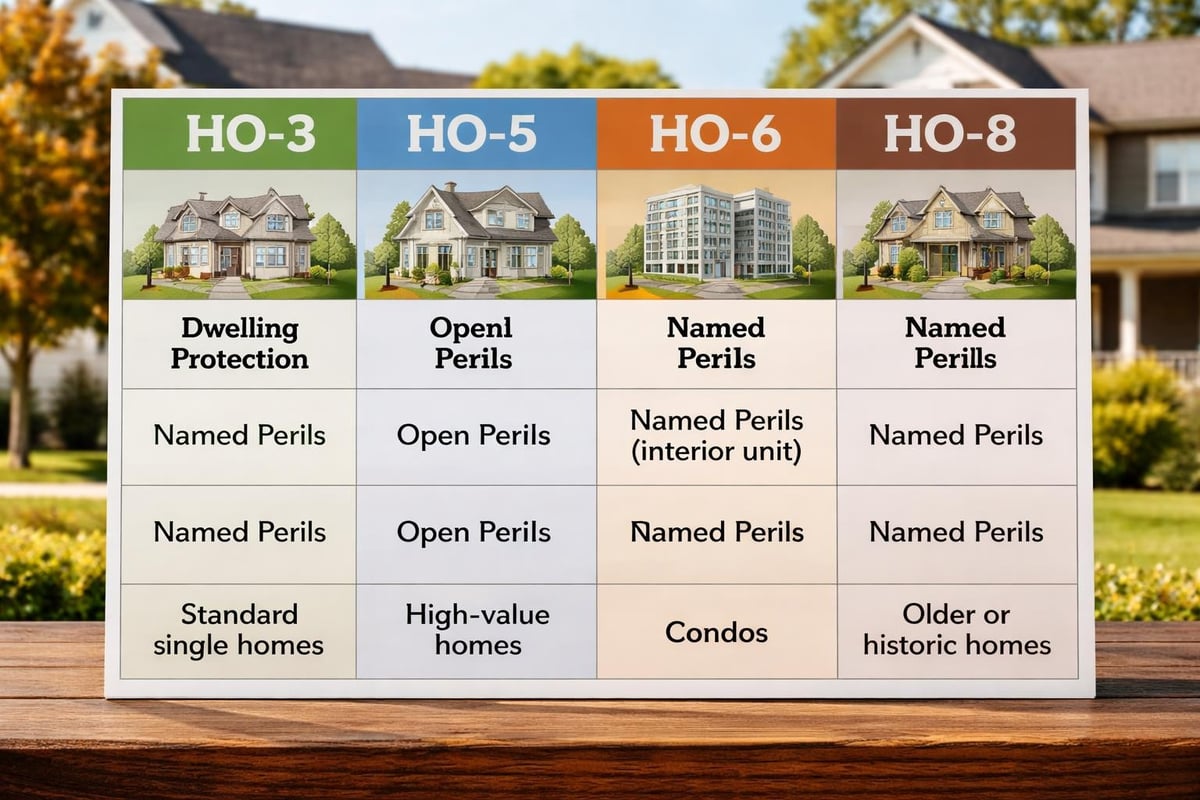
HO-3 policies represent the most common and comprehensive option for single-family homeowners. These "special form" policies cover your dwelling against all perils except those specifically excluded, while personal property receives "named perils" coverage. This combination provides broad protection for most Minnesota homeowners.
Comparing Common Policy Forms
| Policy Type | Who It's For | Dwelling Coverage | Personal Property | Best For |
|---|---|---|---|---|
| HO-3 | Single-family homeowners | All-risk (open perils) | Named perils | Most Minnesota homeowners |
| HO-5 | Premium protection seekers | All-risk | All-risk | High-value homes |
| HO-6 | Condo owners | Limited to unit interior | Named perils | Condos in Minneapolis, Rochester |
| HO-8 | Older home owners | Actual cash value | Named perils | Historic properties |
HO-5 policies offer the most comprehensive property insurance for home coverage available, protecting both dwelling and personal property on an all-risk basis. While premiums run 10-15% higher than HO-3 policies, the broader protection proves valuable for homeowners with significant personal property or those wanting maximum peace of mind.
Minnesota homeowners with older properties built before 1950 might encounter challenges securing standard coverage. Commercial property insurance specialists can help find solutions for unique or hard-to-insure properties.
Cost Factors and Strategies to Reduce Your Premiums
Property insurance for home premiums in Minnesota vary significantly based on multiple factors. Understanding what drives costs helps you make strategic decisions to reduce expenses without sacrificing necessary protection.
Location dramatically impacts premiums. Homes in Minneapolis or St. Paul typically cost more to insure than rural properties in Stearns County due to higher crime rates, increased liability risk, and greater replacement costs. Distance from fire stations also matters-homes more than five miles from fire protection face higher premiums.
Key Premium Drivers for Minnesota Homes
Your insurance costs reflect these critical factors:
- Credit score: Better credit typically means 20-50% lower premiums
- Claims history: Multiple claims in 3-5 years increase rates substantially
- Deductible amount: Higher deductibles reduce premiums by 10-25%
- Home age and condition: Newer roofs, updated electrical, and modern plumbing lower costs
- Security features: Alarm systems, deadbolts, and smoke detectors earn discounts
- Bundle discounts: Combining home and auto insurance saves 15-25%
The Texas Department of Insurance’s guide explains how understanding rate factors helps homeowners make cost-effective coverage decisions, though Minnesota-specific factors like ice dam prevention and winterization matter locally.
Increasing your deductible represents one of the fastest ways to reduce property insurance for home costs. Moving from a $500 to $1,000 deductible typically saves 10-15% annually, while jumping to $2,500 can cut premiums by 20-25%. Just ensure you maintain adequate emergency savings to cover the higher out-of-pocket expense if you file a claim.
Special Considerations for Minnesota Climate and Weather
Minnesota's harsh winters and severe weather patterns create unique insurance considerations. Ice dams form when heat escapes through poorly insulated roofs, melting snow that refreezes at the eaves and causes water to back up under shingles. This water damage often results in expensive claims that can be prevented through proper insulation and ventilation.
Hail storms pose another significant threat to Minnesota properties. The state experiences frequent severe thunderstorms producing golf ball to baseball-sized hail that damages roofs, siding, and windows. Property insurance for home policies typically cover hail damage, but filing multiple claims can lead to policy cancellation or non-renewal.
Weather-Related Coverage Enhancements
Smart Minnesota homeowners consider these additional protections:
- Higher wind and hail coverage: Standard policies cover these perils, but ensure adequate limits
- Water backup coverage: Essential for spring flooding and sewer backup protection
- Code upgrade coverage: Brings damaged homes up to current building codes after losses
- Roof surface coverage: Some insurers offer actual cash value for roofs over 15 years old
- Ice dam damage coverage: Verify your policy covers this common Minnesota claim
When shopping for coverage, ask potential insurers about their claims handling experience with Minnesota-specific perils. Independent brokers working with general insurance agencies can identify companies with favorable track records for weather-related claims in our region.
The Minnesota Department of Commerce requires insurers to clearly disclose coverage limitations for roof damage based on age. Understanding these restrictions before purchasing property insurance for home coverage prevents confusion when filing claims.
Replacement Cost vs. Actual Cash Value Coverage
One critical decision when purchasing property insurance for home coverage involves choosing between replacement cost and actual cash value (ACV) settlement options. This choice dramatically affects how much you receive after a covered loss.
Replacement cost coverage pays to replace damaged items with new equivalents of similar quality without deducting for depreciation. If your ten-year-old roof sustains hail damage, replacement cost coverage pays to install a new roof based on current prices, minus your deductible.
Understanding the Financial Impact
| Coverage Type | Payout Method | Example: 10-Year Roof | Premium Cost | Best For |
|---|---|---|---|---|
| Replacement Cost | New value minus deductible | $15,000 – $1,000 = $14,000 | 10-15% higher | Most homeowners |
| Actual Cash Value | Depreciated value minus deductible | $9,000 – $1,000 = $8,000 | Lower baseline | Older homes, tight budgets |
| Guaranteed Replacement | Full rebuild cost even if exceeds limits | Full replacement regardless | 15-25% higher | Premium homes |
Actual cash value coverage deducts depreciation before paying claims. Using the same example, ACV coverage might only pay $8,000-9,000 for the ten-year-old roof since it had significant wear and already provided years of useful life. You'd need to cover the remaining $6,000-7,000 out-of-pocket to install a comparable new roof.
For most Minnesota homeowners, replacement cost coverage provides superior protection despite higher premiums. The difference typically amounts to $100-200 annually but can save thousands when major losses occur. This proves especially important for roofs, siding, and HVAC systems that depreciate significantly over time.

Documentation and Inventory Best Practices
Proper documentation transforms difficult claims processes into smooth settlements. Creating and maintaining a comprehensive home inventory proves invaluable when filing property insurance for home claims, yet fewer than 30% of homeowners maintain updated inventories.
Digital documentation offers the most convenient approach in 2026. Use your smartphone to photograph or video record every room, opening closets, drawers, and cabinets to capture belongings. Many insurance companies now offer free inventory apps that allow you to catalog items, record purchase prices, and store receipts digitally.
Creating an Effective Home Inventory
Follow these steps for comprehensive documentation:
- Photograph each room: Capture multiple angles showing furnishings and belongings
- Record serial numbers: Document electronics, appliances, and valuable equipment
- Save receipts: Store purchase documentation for high-value items digitally
- Note special items: Catalog jewelry, art, collectibles with detailed descriptions
- Update annually: Review and refresh your inventory each year
- Store securely: Keep copies in cloud storage and off-site locations
For valuable items exceeding standard policy sub-limits-typically $1,500 for jewelry, $2,500 for firearms, and $2,500 for silverware-schedule these items separately on your property insurance for home policy. This endorsement provides broader coverage without deductibles and includes mysterious disappearance, which standard policies exclude.
The South Carolina Department of Insurance’s purchasing guide emphasizes the importance of maintaining detailed inventories and understanding how to document losses effectively, advice that applies equally to Minnesota homeowners.
Working with Independent Insurance Brokers
Independent insurance brokers provide distinct advantages when shopping for property insurance for home coverage. Unlike captive agents representing single insurance companies, independent brokers access multiple carriers, allowing them to compare coverage options and pricing across the marketplace.
This access proves particularly valuable in Minnesota's insurance landscape, where some carriers excel at handling ice dam claims while others offer superior rates for homes with newer roofs or updated systems. Brokers familiar with regional factors can match your specific situation with insurers best suited to your needs.
Benefits of Working with Independent Brokers
Independent brokers deliver value through multiple channels:
- Market access: Compare rates and coverage from 35+ insurance companies
- Specialized knowledge: Understand Minnesota-specific coverage needs and weather risks
- Ongoing advocacy: Assist with claims and policy changes throughout your relationship
- Time savings: Handle comparison shopping, paperwork, and carrier communication
- Expert guidance: Navigate complex coverage decisions and endorsement options
When evaluating brokers, ask about their carrier relationships, claims support process, and experience with properties similar to yours. Local expertise matters-brokers familiar with St. Cloud, Rochester, Duluth, and greater Minnesota understand regional risk factors that impact coverage needs and pricing.
Independent brokers typically earn commissions from insurance companies rather than charging direct fees, meaning their services cost you nothing extra. This arrangement allows them to provide objective advice focused on finding optimal coverage rather than maximizing premiums.
Understanding Policy Limits and Coverage Adequacy
Setting appropriate policy limits for your property insurance for home coverage requires balancing adequate protection against premium costs. Under-insurance represents one of the most common and costly mistakes homeowners make, often discovered only after suffering significant losses.
Insurance companies typically require dwelling coverage at least equal to 80% of your home's replacement cost to avoid coinsurance penalties. Falling below this threshold means the insurer pays only a proportionate share of partial losses, leaving you responsible for the remainder even if the claim falls within your policy limits.
Calculating Adequate Coverage Limits
Most insurance companies for business insurance and personal lines recommend these guidelines:
| Coverage Type | Recommended Limit | Minnesota-Specific Considerations |
|---|---|---|
| Dwelling | 100% replacement cost + inflation guard | Account for premium materials, custom features |
| Personal Property | 50-75% of dwelling coverage | Adjust based on actual belongings value |
| Liability | $300,000-500,000 minimum | Consider umbrella policy for additional protection |
| Other Structures | 10-20% of dwelling coverage | Include detached garages, sheds common in MN |
| Loss of Use | 20-30% of dwelling coverage | Higher limits for extended winter repairs |
The Georgia Office of Insurance provides guidance on setting appropriate coverage limits that protect homeowners without overpaying, though Minnesota's higher construction costs may require adjustments to these baseline recommendations.
Inflation guard endorsements automatically increase your dwelling coverage annually, typically by 2-4%, protecting against rising construction costs. This relatively inexpensive addition ensures your property insurance for home coverage keeps pace with inflation without requiring annual policy adjustments.
Disaster Preparedness and Loss Mitigation
Proactive disaster preparedness significantly reduces both claim frequency and premium costs over time. Insurance companies reward homeowners who invest in loss prevention through premium discounts and favorable underwriting treatment.
Minnesota homeowners should focus prevention efforts on our state's most common perils. Installing ice dam prevention systems-including proper attic insulation, ventilation, and heat cables-reduces winter damage risk substantially. While these improvements require upfront investment, they prevent expensive claims and potential policy cancellations.
Essential Loss Prevention Measures
Implement these protective measures to safeguard your home:
- Roof maintenance: Annual inspections and prompt repairs prevent small issues from becoming major claims
- Gutter cleaning: Clear debris twice annually to prevent ice dams and water damage
- Tree trimming: Remove branches overhanging your roof, especially before winter storms
- Sump pump backup: Install battery backup systems to prevent basement flooding during power outages
- Smoke and CO detectors: Maintain working detectors on every level plus bedrooms
- Security systems: Professional monitoring reduces break-in risk and qualifies for discounts
Water damage represents the most frequent property insurance for home claim type, accounting for nearly one-third of all homeowners claims. Installing water sensors near washing machines, water heaters, and sump pumps provides early warning of leaks before they cause extensive damage.
The NAIC’s consumer guide offers comprehensive information about disaster preparedness and how preventive measures reduce insurance costs while protecting your property investment.
Reviewing and Updating Your Coverage Regularly
Property insurance for home needs evolve as your circumstances change. Annual policy reviews ensure your coverage remains adequate and appropriately priced. Many homeowners purchase policies and never review them until filing claims, often discovering coverage gaps at the worst possible time.
Life changes trigger coverage review needs. Home renovations, additions, or improvements increase your property value and require coverage adjustments. Adding a finished basement, updating your kitchen, or building a deck all increase replacement costs that should be reflected in your dwelling coverage limits.
When to Review Your Property Insurance for Home Coverage
Schedule comprehensive policy reviews following these events:
- Major renovations: Kitchen remodels, additions, finished basements increase home value
- Significant purchases: Acquiring expensive jewelry, art, or collectibles requiring scheduled coverage
- Home office addition: Business equipment may need separate coverage beyond standard policies
- Life changes: Marriage, divorce, or inheritance affecting asset protection needs
- Annual review: Compare rates and coverage with competing carriers each renewal
- Claims-free periods: Long claim-free histories may qualify for loyalty or claims-free discounts
Minnesota's dynamic real estate market means home values fluctuate significantly. Properties in growing areas like St. Cloud and Freeport may appreciate faster than inflation guard endorsements account for, requiring manual dwelling coverage increases to maintain adequate protection.
Working with independent brokers simplifies this review process since they can quickly compare your current coverage against market alternatives without requiring you to contact multiple insurance companies directly.
Protecting your home with comprehensive property insurance for home coverage provides financial security and peace of mind against unexpected losses. Understanding coverage components, exclusions, policy types, and Minnesota-specific considerations empowers you to make informed decisions that balance adequate protection with reasonable costs. Whether you're purchasing your first home in Albany or updating coverage on a longtime Freeport residence, partnering with experienced local professionals ensures you secure optimal protection. Guardian Insurance Services MN offers access to over 35 top insurance companies and personalized service to help you find the perfect policy for your unique situation-contact us today for a comprehensive coverage review and quote.